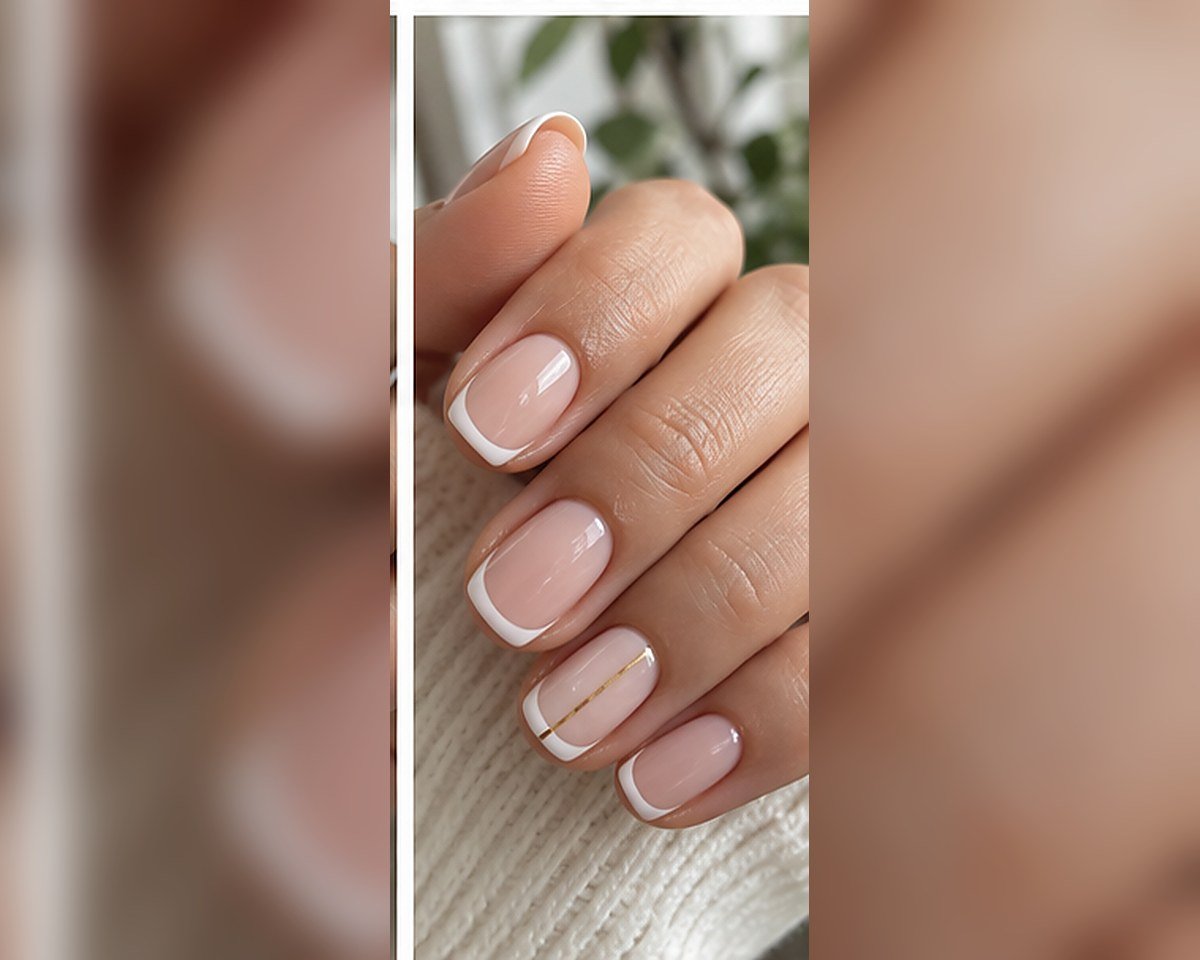
Squoval nails combine a straighter free edge with softened corners, which makes the shape especially practical on short natural nails. You keep more of the clean structure of a square without leaving sharp corners that catch as easily, and the flatter tip gives simple nail art a clear framework.
This page stays focused on short squoval nails and designs that work with their limited surface area and gentler corners. When you are comparing square, round, oval and squoval outlines, compare the shapes first in StyleVeya’s Nail Shapes Guide. For design ideas that are not tied to one nail shape, use Short Natural Nail Designs.
1. Sheer beige squoval nails
A translucent beige keeps the manicure neat while letting the natural nail show through. The straight upper edge makes the finish look especially tidy.
2. Micro French on a squoval tip
Squoval nails are naturally suited to French tips.
Follow the straight center of the free edge, then soften the line slightly near the corners. Keep the tip thin on short nails; a wide band can make the nail plate appear shorter.
See StyleVeya’s French tip nail designs for color and line-width variations.
3. Milky pink with a glossy finish
A semi-sheer pink makes short squoval nails look groomed without drawing attention to exact length. High gloss works particularly well because the reflected light softens the squared outline.
4. Fine double French
Paint one fine line at the edge and a second parallel line just below it. Keep the space between them narrow.
White and beige feel subtle; brown and burgundy create more contrast without requiring a large design.
5. Short red squoval nails
Classic red looks crisp on this shape. Because the top edge is straighter than an oval, red can feel slightly more graphic and modern.
6. Half-moon detail
Leave a small crescent near the cuticle bare and paint the rest of the nail. The negative space helps disguise regrowth and gives a short nail a little more visual length.
7. Thin vertical line
A narrow line running from near the cuticle toward the tip creates a lengthening effect. Place it in the center for a minimal look or slightly off-center for something more relaxed.
8. Chocolate brown gloss
Dark brown suits short squoval nails because the shape keeps the color looking structured. A glossy finish adds dimension and prevents the shade from appearing flat.
If you like deeper tones, StyleVeya’s black nail designs and burgundy nail ideas offer similar high-contrast options.
9. Soft chrome over nude
Apply a fine pearl or champagne chrome over a nude base. The effect catches light without hiding the clean squoval outline.
For more reflective finishes, StyleVeya’s chrome and metallic nail designs show stronger versions.
10. Tiny corner accent
Place one small dot, star or fine line near the outer corner of each nail. The placement mirrors the softened corner of the squoval shape and creates interest without filling the whole surface.
Choose designs that respect the flatter tip
Squoval nails naturally support straight or gently curved details. Micro French, thin vertical lines and small corner accents work because they echo the shape instead of fighting it.
Very pointed motifs can still work, but they create stronger contrast against the softer squared outline.
Regrowth is easiest with sheer or negative-space designs
If you want the manicure to stay neat for longer, a sheer base, half-moon detail or fine French line is usually more forgiving than dense color placed tightly against the cuticle.
Dark shades emphasize filing accuracy
Black, chocolate and burgundy make the free edge and sidewalls more visible. If the corners are uneven, a dark polish can highlight the difference. Shape first, then use color.
Short squoval nails are practical for frequent hand use
The softened corners are less likely to catch than a sharp square, while the flatter center still gives a structured look. That makes the shape useful for people who type, work with their hands or dislike very tapered tips.
Common mistakes
- Rounding so much that the shape becomes oval.
- Leaving the corners completely sharp so the nail remains square.
- Making the French tip too thick and visually shortening the plate.
- Using oversized nail art that hides the clean outline.
How to file a short squoval shape
File the free edge mostly straight, then soften each corner with a few controlled strokes rather than rounding the entire tip.
If you keep filing into the sidewalls, the nail will gradually become oval. If you leave the corners completely untouched, it will remain square. A short squoval should keep a straighter center with softened, comfortable corners.
Squoval is useful for wider nail beds
A straight tip can visually balance a wider nail plate. Very tapered shapes may make the center look wider by comparison, while squoval maintains a more consistent outline from cuticle to tip.
There is no nail-bed rule you have to follow. The shape should feel comfortable and suit the amount of free edge you actually have.
Keep the design proportional
Short nails have less surface area. That does not mean nail art is off-limits. It means scale matters.
Fine tips, small accents, negative space and clean color blocks usually read more clearly than several competing details.
Check corner wear before choosing a very dark polish
The softened corners are one reason squoval is practical, but they are also the part most likely to show wear first if the free edge is used heavily. Deep red, black and chocolate make that wear easier to notice than sheer beige or milky pink.
If you work with your hands a lot, a slightly softer shade or a design with negative space near the edge can make small chips less distracting between manicures.
StyleVeya’s short natural nail designs are useful if practicality is your main priority, while the square nail design collection shows how a straighter outline changes graphic designs.
A short squoval manicure can be elegant precisely because it does not try too hard. Clean filing, a tidy cuticle line and one controlled idea are often enough.