
Long wavy hair already has movement, so the haircut does not need to manufacture it everywhere. The main job is to keep the weight balanced so the wave can form without the crown lying flat or the ends becoming thin and frizzy.
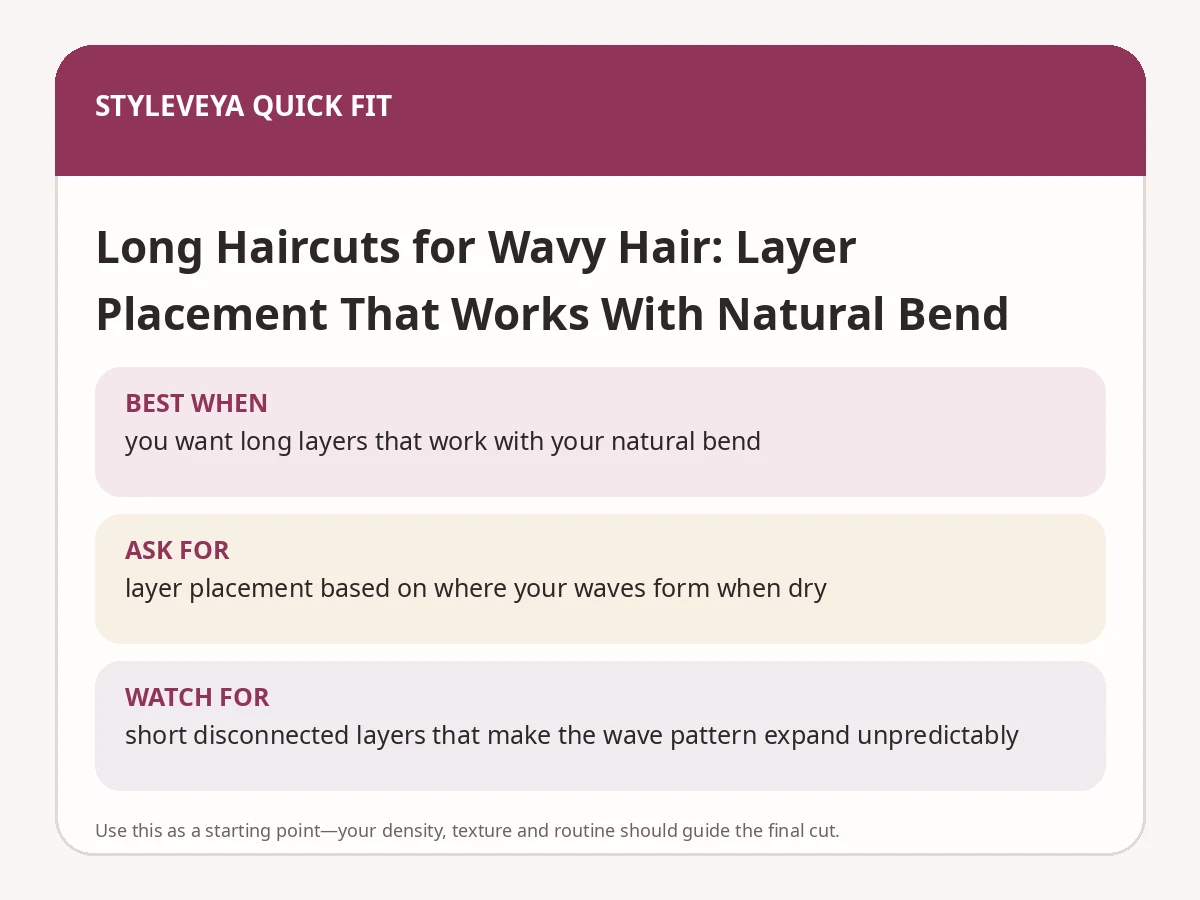
Watch how the hair bends when dry, then place layers around that pattern instead of cutting only from wet length. Short Haircuts for Wavy Hair shows the same principle at a shorter length.
Long layers should follow the wave, not fight it
A layer that ends where the hair naturally changes direction can reinforce movement. Random short layers can create puffiness or make one section spring more than the rest.
For loose waves, fewer layers may be enough. Stronger S-waves can support more shape through the mids.

Protect the ends so the length still looks healthy
Long wavy hair can look sparse if too much density is removed from the bottom. A U-shaped or softly rounded perimeter often keeps the ends substantial while preventing a heavy straight line.
Face framing can add lightness around the front without sacrificing the back length.
Humidity and density affect the finished width
Fine waves need weight to avoid frizzing apart. Thick waves may need internal bulk control so the sides do not become too wide.
Styling, maintenance and grow-out
If you usually air-dry, the stylist should see the hair in that state before cutting. A salon blowout can hide where the natural wave expands, flattens or changes direction.
Show the stylist how your waves actually dry
- Show your normal dry wave pattern.
- Ask where each major layer will land when dry.
- Keep enough density through the ends.
- Discuss whether the crown needs lift or simply less weight.
- Explain your usual humidity and styling routine.
Choose layers by wave strength, not by a universal formula
Loose 2A-style movement and stronger S-waves do not need the same amount of layering. Hair with a softer bend often looks fuller with fewer, longer layers, while stronger waves can support more separation through the mid-lengths.
Create enough release for the wave to form while keeping enough weight for the ends to stay substantial.
Fine wavy hair needs a different strategy from thick wavy hair
Fine wavy hair usually benefits from a stronger perimeter and fewer internal layers. Thick wavy hair can carry more internal shaping, especially if the sides become bulky or the crown collapses under the weight.
If your hair is both fine and wavy, compare shoulder-length haircuts for fine wavy hair for more targeted guidance.
Face framing should still work when the hair is tied back
Long face-framing pieces can add movement without making the front difficult to manage. If you regularly wear a ponytail or bun, decide whether the shortest pieces should still reach the tie-back point.
This is often more useful than choosing face framing only from a styled reference photo.
Humidity should influence how aggressively weight is removed
Wavy hair can expand significantly in humidity. Removing too much weight may make that expansion more obvious, especially through the sides. If your climate is humid, ask for enough internal movement to prevent heaviness without stripping the perimeter.
Think about grow-out before choosing the shortest layer
Very short crown layers can create more immediate lift, but they also take longer to grow back into the rest of a long haircut. If you want a low-commitment change, begin with longer layers and adjust later.
Parting can change the apparent volume of long waves
A side part moves more hair across the crown and can create lift without changing the layer pattern. A center part keeps the front balanced but may show flatness more clearly if the roots naturally fall away from the middle.
Before adding short crown layers purely for volume, test the part you actually wear and see how much difference it already makes.
Second-day waves should influence the cut
Long waves often relax overnight. If the crown flattens but the lower half still looks good, the haircut may only need enough upper movement to make refreshing easy rather than more layers everywhere.
If the ends lose definition first, check whether product weight, friction or worn ends are the bigger issue before removing more density.
Long hair can be layered and still remain easy to tie back
If ponytails, braids or buns are part of your routine, keep the shortest face-framing sections long enough to reach them. You can still create visible movement through the front without cutting multiple short pieces that fall out every time the hair is secured.
Drying time is part of the maintenance calculation
Long wavy hair can be easy to style but still take a long time to dry. If that is the part you dislike most, a modest reduction in length may help more than aggressive layering.
The haircut should reduce the work you actually notice, not just create more movement in a salon photo. If your usual routine is air-drying, ask for the finished cut to be checked after the natural wave has settled so the layer relationships are judged in the state you will actually wear them.
Match the layers to your wave pattern
- Choose fewer long layers if your ends are fine or your waves are loose.
- Choose more internal shaping if the hair is dense and becomes too wide through the sides.
- Keep the perimeter fuller if you want the length to look substantial when air-dried.
- Use face framing selectively if you need the front to remain easy to tie back.
Frequently asked questions
Do long wavy haircuts need lots of layers?
No. The amount depends on density and wave strength. Some loose waves look best with only a few long layers.
What perimeter works for long wavy hair?
A soft U-shape or rounded line often keeps the ends full while allowing movement.
Should wavy hair be cut dry?
A dry assessment is helpful because the wave pattern and spring can change the apparent length significantly.