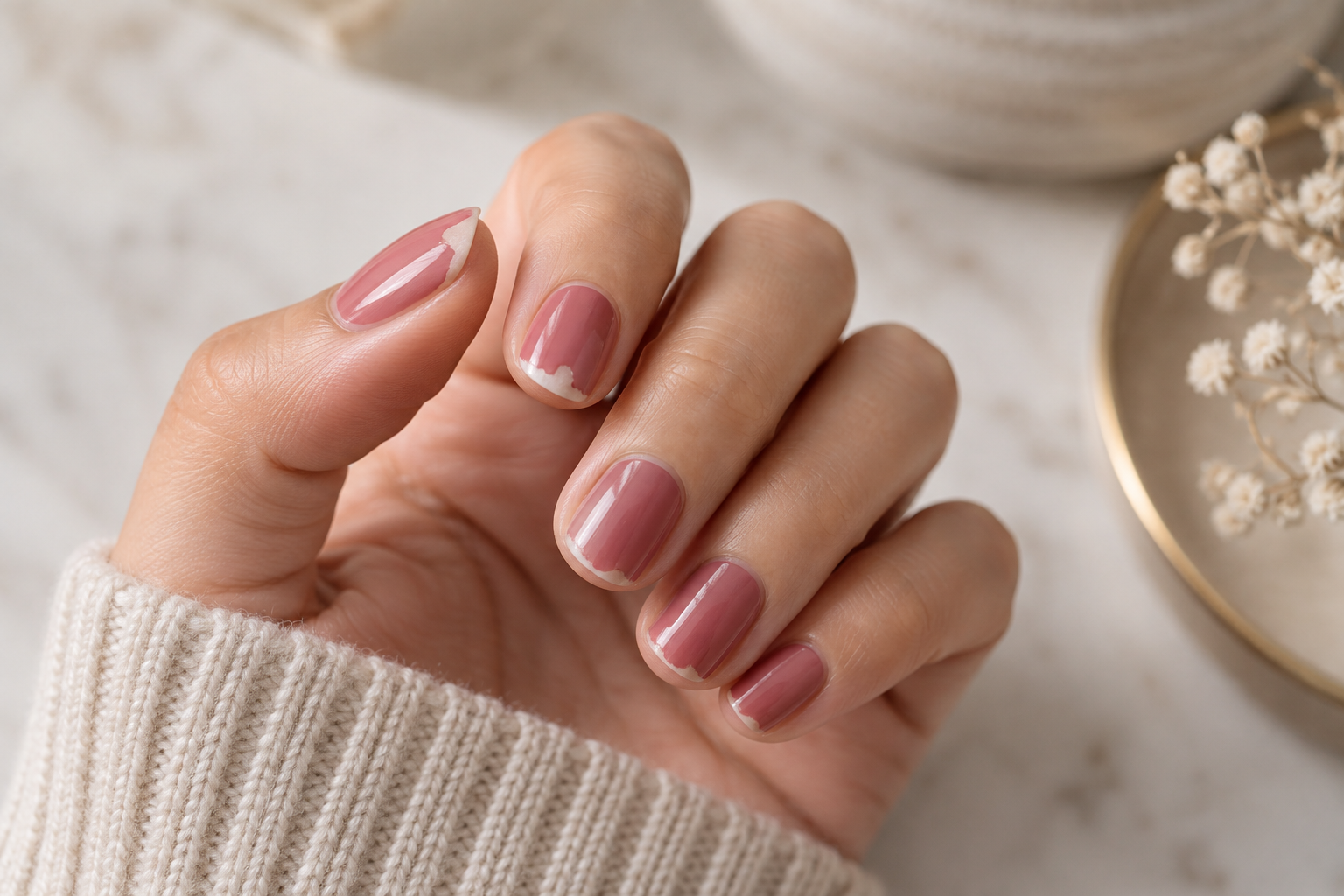
You can have a manicure that still looks glossy near the cuticle while the tips are already showing tiny white chips. That pattern is so common because the free edge of the nail lives a much harder life than the rest of the nail plate.
It hits keyboards, catches on fabric, opens packaging, scrapes against countertops and absorbs repeated wet-dry cycles. Even a carefully applied manicure is usually tested first at the tip.
The useful fix depends on why the edge is failing. More top coat is not always the answer.
The free edge gets the most mechanical wear
The tip of the nail is the part most likely to make contact with objects during the day.
Think about how you type, fasten jewelry, pull open drawers or pick up coins. The polish at the edge experiences repeated friction long before the polish in the center of the nail does.
This is one reason shorter nails can sometimes keep polish looking tidy longer than very long nails: there is less leverage at the free edge and less surface extending beyond the fingertip.
If you prefer practical lengths, StyleVeya’s short natural nail designs focus on manicures that still look intentional without requiring a long extension.
Nail shape changes where pressure lands
A very sharp square corner can catch more easily than a softened corner. A heavily tapered almond nail concentrates more of its length into a narrower tip.
Neither shape is automatically “bad,” but the stress points are different.
A short squoval shape is popular partly because the center of the tip stays relatively straight while the corners are softened. StyleVeya’s squoval nail designs for short nails show how that practical shape can still look polished.
For a full comparison of almond, oval, square, round and squoval, use the nail shapes guide.
Polish does not adhere well to oil or residue
If the nail plate has oil, lotion, cuticle remover or filing dust on it, polish may not bond evenly.
That does not mean the natural nail needs to be aggressively dehydrated. It means the surface should be clean and prepared according to the polish system you are using.
A manicure applied immediately after a rich hand cream can look beautiful at first and still lift sooner than expected around the edges.
Very thick coats can chip as one piece
More polish does not necessarily mean more durability.
Thick coats take longer to dry fully and can remain softer underneath even when the surface feels set. When a thick layer catches at the free edge, a larger piece may lift away.
Thin, even coats usually cure or dry more predictably than one heavy coat.
Wrapping the tip can help—but only if it stays thin
Many manicure techniques include “capping” or “wrapping” the free edge by lightly carrying base coat, color or top coat across the tip.
Carry each layer around the free edge so the coating does not stop abruptly on the top surface.
The key word is lightly. A bulky ridge of product at the tip can create its own weak point and may make a short nail look thick.
Water exposure changes the natural nail underneath
Natural nails absorb water and can become more flexible after prolonged exposure. Repeated wetting and drying can place stress on the polish layer sitting above them.
The American Academy of Dermatology recommends protecting nails from excessive water exposure and notes that too much water can contribute to splitting, peeling or breakage. Its healthy-nail tips are a useful general reference.
For a manicure, that means gloves during long dishwashing or cleaning sessions are not only about protecting the color from chemicals; they also reduce prolonged soaking.
Your nails are not tools
Opening cans, scraping labels and prying apart packaging puts direct force on the free edge.
The AAD specifically advises against using nails as tools because doing so can contribute to chipping, splitting or lifting of the nail.
If polish always chips on the same finger—often the index finger or thumb—watch what that nail does during an ordinary day. The pattern may be behavioral rather than a flaw in the polish.
Chipping and peeling are not exactly the same problem
A small chip at the corner suggests local impact or wear.
A whole sheet of polish peeling away from the nail can point more toward adhesion, preparation, product compatibility or moisture getting underneath the coating.
If the same manicure system repeatedly peels intact from several nails, adding a thicker top coat is unlikely to solve the root problem.
Short almond nails need a gentle taper
On short nails, an almond shape needs enough sidewall strength to support the tip.
Over-filing the sides to force a dramatic almond can leave the edge mechanically weaker and more prone to catching or breaking.
StyleVeya’s short almond nail designs use a softer taper that fits real-life lengths rather than trying to imitate an extra-long extension.
Top coat cannot compensate for a worn edge forever
Refreshing top coat can restore gloss and add a little protection, but once the edge is already damaged, repeatedly painting over a chip often creates a visible bump.
If you want to extend the manicure, smooth the damaged area carefully and repair it according to the polish system rather than building layer after layer over a loose edge.
Choose designs that tolerate tip wear
Some manicures show tiny chips more obviously than others.
A very dark solid color creates strong contrast against the natural nail when the tip wears. Sheer nudes, jelly finishes and negative-space designs can hide minor growth and edge wear more gracefully.
If practicality matters more than perfect opacity, compare StyleVeya’s simple nail designs and milky white nail ideas.
A durability checklist before blaming the polish
- Keep the nail surface clean before application.
- Use thin, even coats rather than one heavy layer.
- Lightly cap the free edge if the product system recommends it.
- Avoid using your nails to pry or scrape.
- Wear gloves for prolonged cleaning or dishwashing.
- File snags before they turn into larger chips.
- Choose a shape that suits your natural nail length and daily routine.
A manicure will always experience wear eventually. Polish will always wear eventually, so focus on reducing the avoidable stress that makes the tips fail days before the rest of the manicure.
When the free edge is shaped sensibly, prepared cleanly and treated like part of your hand rather than a miniature tool, polish usually has a much better chance of wearing evenly from cuticle to tip.