
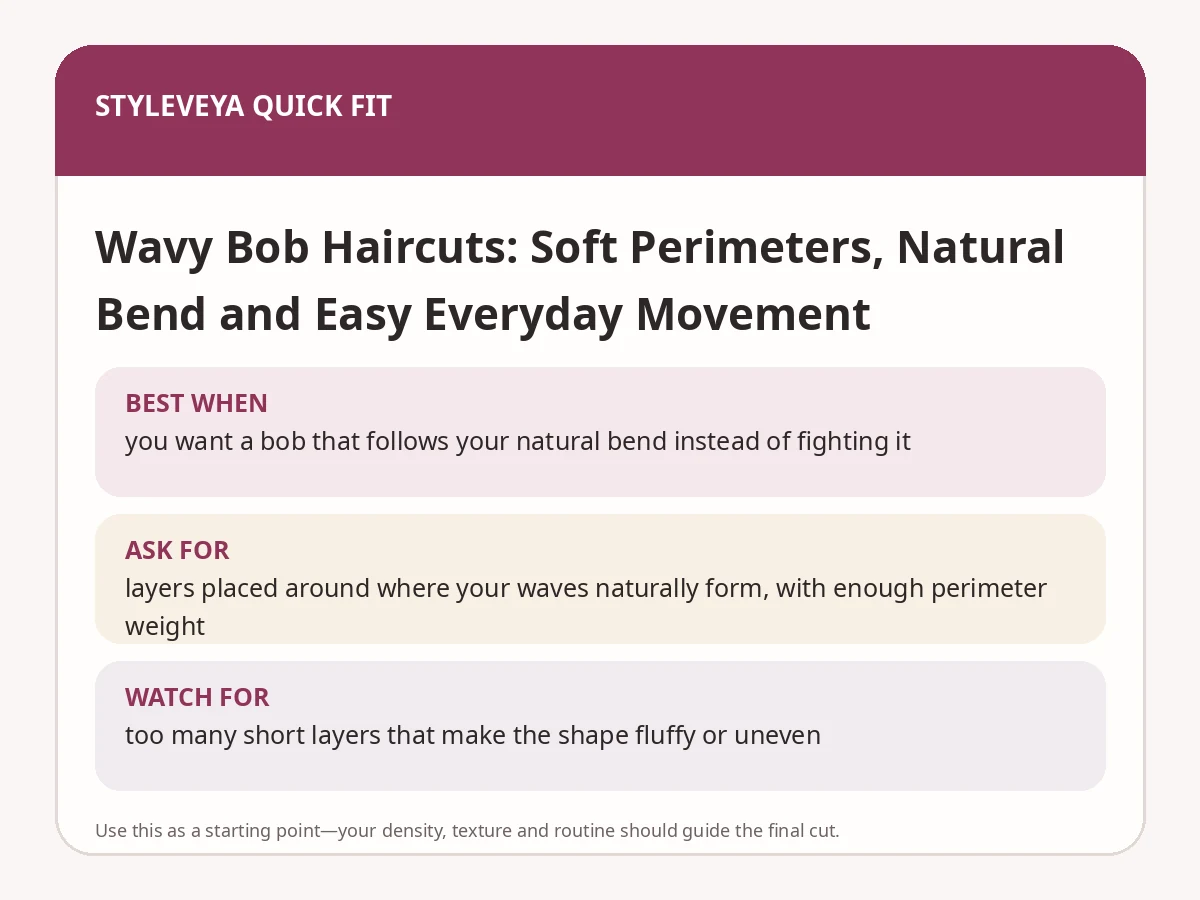
A wavy bob works best when the haircut cooperates with the bend already in the hair. Too much layering can make the ends scatter; too little can make a dense wave pattern sit heavy. Keep enough structure for the bob shape to remain visible while letting the natural wave provide the movement.
Length also changes how the wave behaves. A jaw-length bob can spring up and feel playful; a neck-length bob gives more room for an S-wave to form. If you want more length, compare Long Bob Haircuts.
Let the wave pattern choose the layer placement
Look at where the hair naturally bends when dry. Layers that begin at those points usually feel more intentional than copying a straight-hair diagram.
For loose waves, a mostly solid perimeter with a few longer layers can be enough. Stronger waves may need more internal shaping.

The perimeter should still read as a bob
Texture can soften the bottom edge, but the cut needs enough visible weight to avoid looking like an overgrown layered haircut.
A lightly point-cut edge or subtle graduation can keep the outline polished without making it stiff.
Fine waves need weight; thick waves need room
Fine wavy hair often looks fuller with fewer layers. Thick wavy hair may need internal bulk removal so the sides do not expand too widely.
Styling, maintenance and grow-out
A practical wavy bob should air-dry or diffuse without requiring you to rebuild the shape from scratch. Ask for a cut that still looks balanced on lower-effort days, not only after a salon blowout.
Look at the haircut on a normal wash day rather than judging it only after round-brush styling. If the shape collapses unless every section is curled in the same direction, the cut may be relying on styling more than on the natural wave. A good everyday version should still have a readable perimeter when some sections bend more strongly than others.
Plan the dry length, not only the wet cutting line
Wavy hair can shorten as it dries, and the amount is not always equal around the head. One side may lift more, the front may spring higher, or the nape may stay comparatively straight. Before taking the cut shorter, identify the shortest dry point you are comfortable wearing.
This matters most around the jaw and shoulders. A bob that sits neatly below the jaw while wet can rise into a much more compact shape after drying. Around shoulder level, even a small change in length can decide whether the ends turn under, kick outward or sit on top of the shoulder.
Layered wavy bob vs one-length bob: which works better for wavy hair?
A mostly one-length wavy bob keeps more visible weight through the bottom. That can help fine or lower-density hair look fuller and can give loose waves a clearer outline. It may feel too bulky, however, when dense waves stack heavily at the sides.
Soft graduation or restrained internal shaping can release some of that weight without turning the cut into a heavily layered style. Look at where the bulk is actually building. Removing hair everywhere because the sides feel heavy can leave the perimeter thin while the problem area remains.
Fringe changes the maintenance more than the bob itself
A wavy bob can be easy to live with until a fringe is added. Shorter front pieces react quickly to cowlicks, humidity, sleep and natural parting, so decide separately how much daily attention you want to give the front.
Long curtain pieces or cheekbone-level framing usually offer more flexibility because they can be swept, tucked or blended back into the bob. A shorter full fringe creates a stronger change and may need more deliberate drying. If fringe is the unresolved part of the cut, compare Bangs and Fringe Ideas before shortening the front.
Your part can change the apparent width of the bob
A middle part distributes the front sections more evenly. A side part shifts more hair to one side and can create extra root lift or a heavier sweep. If you regularly change your part, mention that during the consultation so the front layers are not designed to work in only one position.
You can test this before changing the haircut at all: wear the part in each position on ordinary days and notice where the widest point of the bob moves. The Side Part vs Middle Part guide goes deeper into that comparison.
Use grow-out as part of the haircut decision
A very precise short bob shows growth sooner because the perimeter moves away from its original line. A softer wavy bob can be more forgiving, but extra length may change where the wave bends or where the ends meet the shoulders.
Think about what usually bothers you first: loss of the clean outline, bulk at the sides, a fringe dropping into the eyes, or the ends beginning to flip. That gives the next appointment a clear purpose instead of trimming automatically because a fixed number of weeks has passed.
Bring these wavy-bob details to the salon
- Show your natural wave pattern before the hair is straightened.
- Choose the dry length, allowing for spring-up.
- Ask where the first layer will begin.
- Say whether preserving a full perimeter matters.
- Explain whether you usually air-dry or diffuse.
Jaw length, neck length and longer bobs behave differently
A jaw-length wavy bob creates a compact shape and can spring noticeably when the hair dries. A neck-length bob gives the wave more room to form, while a slightly longer bob usually feels softer and easier to tuck back.
If you are unsure how short to go, choose the dry endpoint first and then plan the layers around it.
Fine wavy hair usually needs a stronger perimeter
Fine waves can lose density quickly when too many short layers are added. A mostly solid edge with a few longer internal layers often gives more body while still allowing movement.
If fullness matters more than dramatic texture, keep the shortest layer lower.
Thick wavy hair may need hidden weight removal
Dense waves can become too wide through the sides if the cut is completely solid. Internal weight removal can help without making the outer edge look thin.
Use internal shaping to control the movement without heavily thinning the ends.
Face framing should connect to the bob
Shorter pieces around the face can soften the front view, but they should still connect into the main shape. If the face frame is much shorter than the rest, it can read like a separate haircut.
Humidity should influence the amount of layering
Wavy hair often expands in humid weather. If your hair already becomes wide, aggressive layering may increase that effect. Ask for enough movement to prevent heaviness without removing the weight that keeps the outline controlled.
Which wavy bob shape fits your hair?
- Choose a stronger perimeter if your waves are fine or your ends are sparse.
- Choose more internal shaping if your hair is dense and expands at the sides.
- Choose a slightly longer bob if easy tuck-back and softer grow-out matter.
- Choose jaw length if you want a more compact, visibly short silhouette.
Frequently asked questions
Is a wavy bob low maintenance?
It can be, especially when the cut follows the natural wave and does not depend on precise heat styling.
Should wavy bobs have layers?
Often a few well-placed layers help, but the amount depends on density and how strongly the hair bends.
What length is best for a wavy bob?
There is no universal length. Jaw, neck and slightly longer bobs all work; choose based on shrinkage, density and how much movement you want.