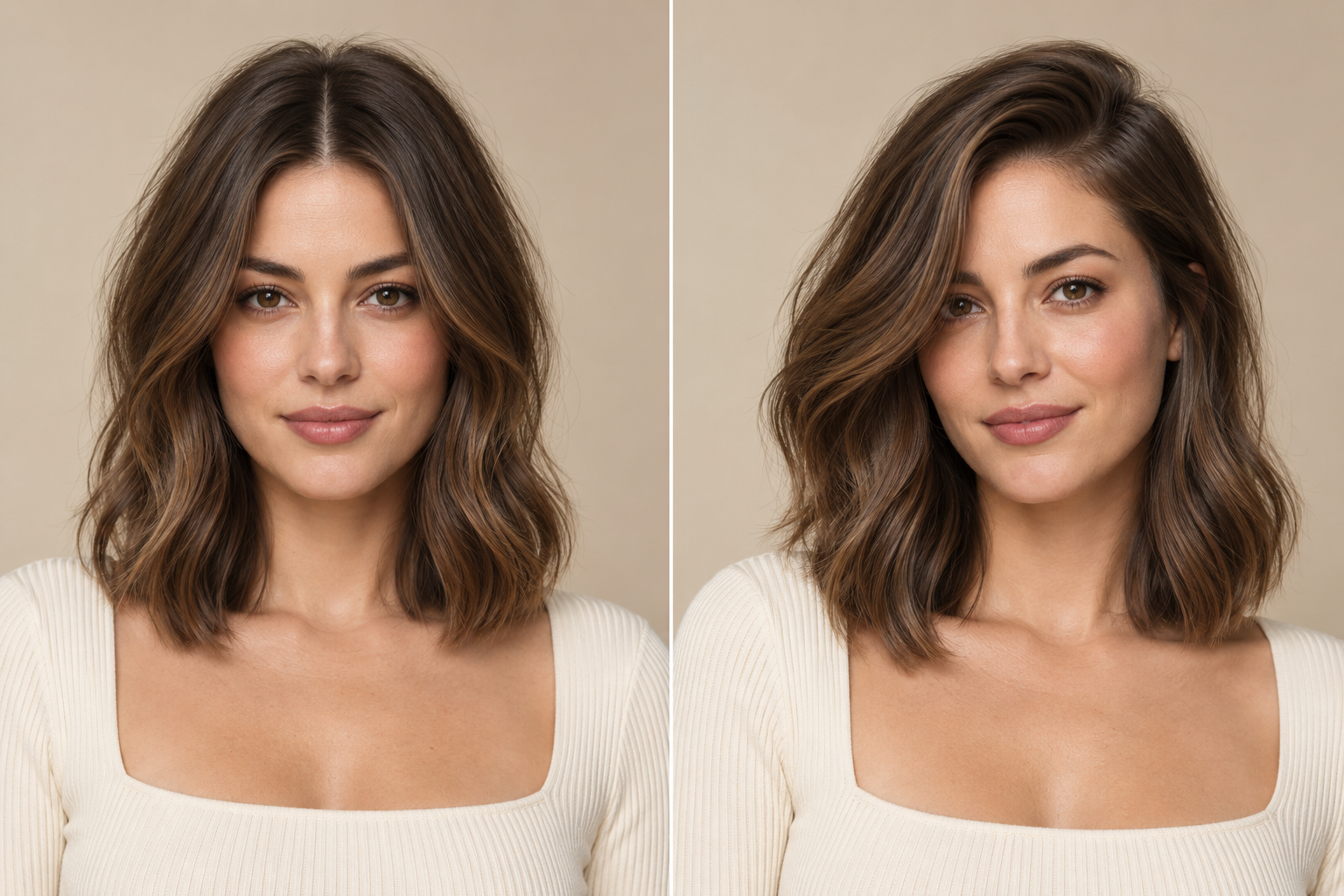
A middle part and a side part can make the same haircut look like two different cuts. Nothing about the layers has changed, yet the crown can look fuller or flatter, the face-framing pieces can land in a different place, and one side can suddenly feel much heavier than the other.
That is why choosing a part is more useful when you treat it as a shape decision, not a face-shape rule. The right part is the one that works with your growth pattern, density, fringe, styling habits and the way you want the haircut to move on ordinary days.
What actually changes when you move the part?
Hair is not distributed evenly when you move from the center to one side. A side part transfers more hair across the top of the head, which can create lift on one side and extra weight on the other. A middle part distributes the visible front sections more evenly, which makes symmetry easier to see.
The difference becomes especially obvious in shorter haircuts, bobs and layered cuts because there is less length to pull the shape downward. On long hair, the part still changes the front, but the overall silhouette may shift less dramatically.
If you are still choosing the haircut itself, start with StyleVeya’s haircut decision guide. Parting should refine a cut that already suits your texture and routine rather than rescue one that does not.
Try this before changing your haircut
Before asking for more layers, bangs or extra volume, move your part for three normal days. Do not judge it only in front of the mirror immediately after styling.
- Notice whether one position gives you easier root lift.
- Check whether the front stays out of your eyes.
- See how the part behaves after a few hours, not just after blow-drying.
- Look at the back and sides as well as the front.
- Pay attention to whether you keep pushing the hair back to its old position without thinking.
If a new part only works when you constantly correct it, the problem may be the natural growth direction rather than your styling skill.
What a middle part does well
A middle part gives the front of the haircut a balanced starting point. If you have matching face-framing pieces on both sides, it shows their length clearly. It can also make a bob or long layered cut feel cleaner because both sides fall from the same center line.
On fine hair, however, a long-established middle part can sometimes expose a very flat root line. That does not mean a center part is “wrong.” It may simply mean the roots have learned to lie in that direction. Drying the front briefly in the opposite direction and then letting it fall back can create lift without changing the cut.
If your main concern is fine-hair fullness, compare StyleVeya’s fine-hair haircut ideas before assuming the part alone has to create all the volume.
What a side part changes
A side part moves more hair across the top, which often creates immediate height near the front. That can make the crown feel fuller without cutting shorter layers.
The trade-off is asymmetry. One side gains hair; the other gives it up. On thick hair, the heavier side may become bulky. On very fine or lower-density hair, the lighter side may reveal more temple or scalp than you expected.
A soft side part usually gives you more flexibility than an extremely deep one. You still get some sweep and lift, but you are less likely to create a dramatic difference in weight from left to right.
Your cowlick gets a vote
The front hairline often decides which part feels effortless. A cowlick can push one section up, split a fringe, or make a perfectly straight part wander after the hair dries.
Do not choose a part by forcing the first inch of hair to behave like someone else’s reference photo. Work with the direction the roots already prefer unless you are happy to style against them every day.
If you have a strong front cowlick and are considering bangs, StyleVeya’s bangs and fringe guide is worth reading before the cut. Fringe length and parting have to work together.
Parting matters before bangs are cut
A fringe cut for a center part may not sit the same way when swept to one side. Curtain bangs are especially sensitive because the opening point determines where the shorter pieces fall.
If you regularly switch between center and side parts, tell your stylist before any front section is shortened. A slightly longer, more flexible fringe can be easier than a highly precise shape designed around one fixed part.
Also bring the part you wear most often to the appointment. Turning up with the hair slicked straight back or parted differently can hide the behavior the stylist actually needs to see.
Bobs can change dramatically with a new part
A blunt bob with a middle part can look graphic and even. Move it to the side and the front may suddenly feel fuller, but one corner can also appear longer because more hair is crossing the head.
Layered and wavy bobs may respond even more strongly. A side part can release more movement on the heavier side while flattening the lighter side. Before changing the cut, test the part on dry hair and look at how the perimeter sits.
For shape comparisons, see StyleVeya’s bob haircut hub and wavy bob ideas.
Layers should be checked in the part you actually wear
Face-framing layers are often cut while the hair is divided neatly. That makes the technical work easier, but the final check should happen after the hair is returned to its everyday part.
If you wear a side part, the heavier side may need to be visually balanced against the lighter side. That does not always mean cutting both sides differently; sometimes it means adjusting the angle, removing a little bulk, or preserving extra length where the hair naturally travels farther.
If you change your part often, long adaptable layers usually tolerate that better than very short, highly directional pieces. StyleVeya’s medium layered haircut ideas show several softer approaches.
Wavy and curly hair need a dry reality check
Texture can make a part look completely different after drying. A middle part may separate into two balanced wave patterns, while a side part may stack more curls on one side and create extra height.
That can be beautiful, but it is not always predictable while the hair is wet. If you usually wear your natural texture, judge the part after the waves or curls have fully formed.
Do not keep combing through the roots once the pattern has set just to force a mathematically straight line. A slightly irregular part often looks more natural on textured hair and creates less disruption to the curl pattern.
A new part will not permanently “train” every head of hair
You may hear that hair can always be trained into a new part. Sometimes repeated styling does make a new direction easier. Sometimes the growth pattern remains stubborn.
If the roots continually spring back, decide whether the result is worth the daily effort. A haircut should support your routine, not create a new task you resent every morning.
How to create lift without overworking the roots
If your preferred part looks flat, try the smallest intervention first. While drying, lift the root area and direct it briefly against the way it normally falls. Once it is mostly dry, return it to the intended part.
You can also move the part a few millimeters rather than jumping from dead center to a deep side. That tiny shift often creates enough root disturbance to give the hair more height.
Fine hair usually benefits from lightweight styling rather than heavy oils or creams near the root. If product weight is part of the problem, StyleVeya’s article on why fine hair gets flat after conditioner explains how placement and layering of products can affect lift.
What to tell your stylist
Instead of saying only “I wear a side part,” give the stylist the useful details:
- Which side you normally part on.
- Whether you switch parts during the week.
- Where your cowlick or stubborn growth pattern sits.
- Whether you tuck one or both sides behind your ears.
- Whether you air-dry or blow-dry most days.
- Whether your priority is symmetry, lift, softness or easy grow-out.
The StyleVeya Stylist Brief can help turn those habits into a clearer consultation note.
Parting should serve the haircut you actually wear
Do not choose a middle part because someone says it is more modern, and do not choose a side part because someone says it is more flattering. Those statements ignore too much: texture, density, growth direction, fringe and the haircut itself.
Use the part as a low-commitment styling tool. Test it before cutting. Watch what the roots do after several hours. Check how the front connects with the rest of the haircut. If the new position gives you the shape you want without becoming a daily fight, keep it. If it does not, that is useful information too.