Fine hair can look freshly washed at breakfast and strangely heavy by lunch, even when the scalp is clean. Conditioner often gets blamed first, and sometimes that is fair—but the problem is usually more specific than “conditioner is bad for fine hair.”
What matters is where the product goes, how rich it is, how much you use and what else is layered on top of it. Fine strands have less physical diameter than coarse strands, so a small amount of residue can change the way the hair hangs. Fine hair still benefits from conditioning; the more useful adjustment is to keep softness where it is needed without coating the areas responsible for lift.
Fine hair and low-density hair are not the same thing
Fine describes the thickness of each individual strand. Density describes how many strands are growing across the scalp. Someone can have fine hair with high density, or fine hair with low density.
That distinction matters because the same conditioner can behave differently on two people with “fine hair.” High-density fine hair may tolerate more moisture through the lengths, while lower-density fine hair can show product weight much sooner around the crown and front.
To compare which cuts preserve the most visible fullness, StyleVeya’s fine-hair haircut hub is the better place to start. Product technique works best when the haircut itself is not already removing too much density.
Conditioner near the roots is often the first problem
Conditioner is designed to smooth, soften and reduce friction. Those are useful jobs, but they are not always useful at the root of fine, straight or easily flattened hair.
If you apply a rich conditioner from scalp to ends, the short hairs around the crown may lie closer to the head as they dry. The effect can look like oiliness even when the scalp is not especially oily.
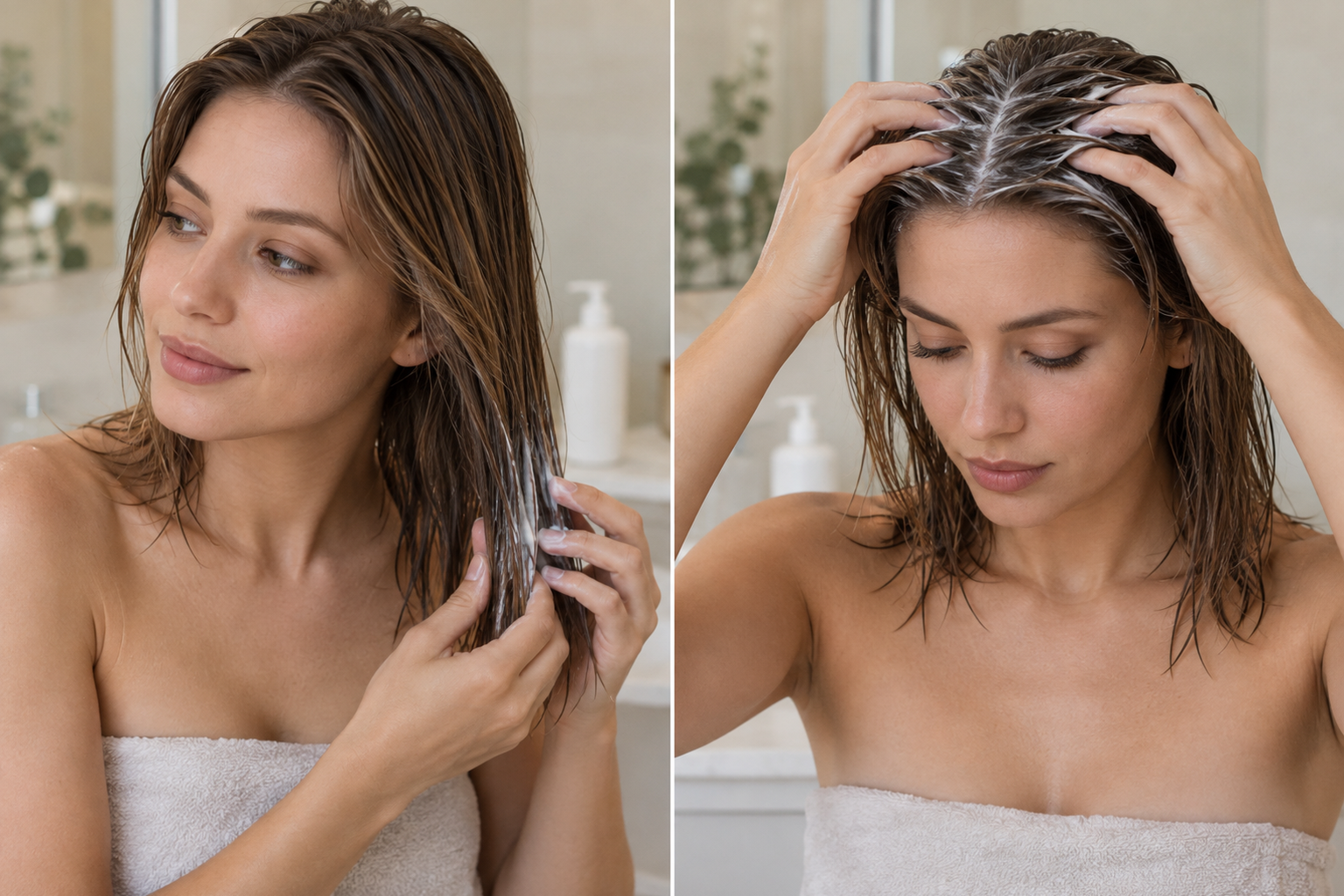
For many people with fine or straight hair, the simplest adjustment is to keep conditioner mainly on the mid-lengths and ends. The American Academy of Dermatology gives similar general guidance for straight or fine hair, recommending conditioner on the ends rather than automatically coating the full length. Their healthy-hair guidance is a useful reference for basic washing and conditioning habits.
The formula may simply be too rich
Words such as “repair,” “intense moisture,” “butter,” “oil” and “deep nourishment” are not warnings by themselves. They simply suggest that the formula may be designed for hair that needs more coating or lubrication.
On fine hair, a lighter rinse-out conditioner can often provide enough slip without leaving the same amount of weight behind. That does not mean every lightweight product will work or every rich product will fail. Hair that is bleached, heat-damaged or naturally dry may still need more conditioning through the ends.
A useful test is to change one variable at a time. If you switch shampoo, conditioner, leave-in spray and styling cream all at once, you will not know which product improved—or worsened—the result.
Using less can work better than changing brands
Fine hair often needs less product than the amount demonstrated in advertising or on social media.
Start with a smaller amount, spread it between your hands and work it through the lower half of the hair. Add more only where the ends still feel rough. The hair closest to the scalp usually receives enough conditioning indirectly when you rinse.
This matters even more when the haircut is intentionally designed for lift. A cut such as a medium shag for fine hair relies on movement through the crown. Heavy conditioning directly over those shorter layers can flatten the feature the haircut was meant to create.
Leave-ins can quietly double the weight
Sometimes the rinse-out conditioner is not the real issue. The routine that follows it is.
A leave-in conditioner, smoothing serum, heat protectant, curl cream and finishing oil can each be reasonable on their own. Layered together on fine hair, they may create more coating than the hair can carry while still looking airy.
Look at the entire routine rather than blaming the last product you applied.
If you use heat, keep a heat protectant where needed, but ask whether every additional leave-in is solving a different problem. Two products doing the same job can make fine hair feel clean but look heavy.
Rinsing matters more than people think
Fine hair can hold product between densely packed strands, especially around the nape and behind the ears.
Rinse longer than you think you need to. Lift sections of hair so water reaches underneath rather than only running over the surface. Residual conditioner at the back of the head can create a flat or waxy patch that looks like poor styling.
Do not compensate by making the hair too dry
Once someone decides conditioner is flattening the hair, the temptation is to skip it completely or switch to aggressive cleansing every day.
That can create another problem: rougher ends, more tangling and more breakage from brushing. The better target is balance—clean roots, conditioned ends and only enough styling product to support the finish you actually wear.
The AAD also advises matching washing frequency and products to hair type rather than following one schedule for everyone. Fine, straight hair may need more frequent cleansing than dry, curly or very textured hair, but that does not mean the lengths need to be stripped every time.
The haircut changes how product weight shows up
A blunt or stronger perimeter can tolerate a little more smoothing because the outline already carries visual weight. Highly layered fine hair exposes the effect of product faster because individual sections separate more easily.
If your priority is a simple routine, compare StyleVeya’s low-maintenance haircuts for straight fine hair. A simpler hair routine comes from matching the cut and products instead of expecting styling products to rescue a shape that does not suit your habits.
A simple reset routine
If your hair has started feeling flat and you are not sure why, try this for several washes:
- Shampoo the scalp thoroughly rather than rubbing shampoo through every inch of the hair.
- Use a small amount of conditioner from roughly ear level downward.
- Rinse carefully, especially at the back of the head.
- Use one lightweight styling product rather than several overlapping products.
- Judge the result after the hair is completely dry, not while it is still damp and naturally heavier.
If the hair regains lift, add back products one at a time. That gives you a much clearer answer than continuously buying new formulas.
Fine hair does not need to feel stripped in order to look full. It usually needs clean placement and restraint: moisture where the strand benefits from it, less coating where lift matters, and a haircut that still looks intentional without a shelf full of products.