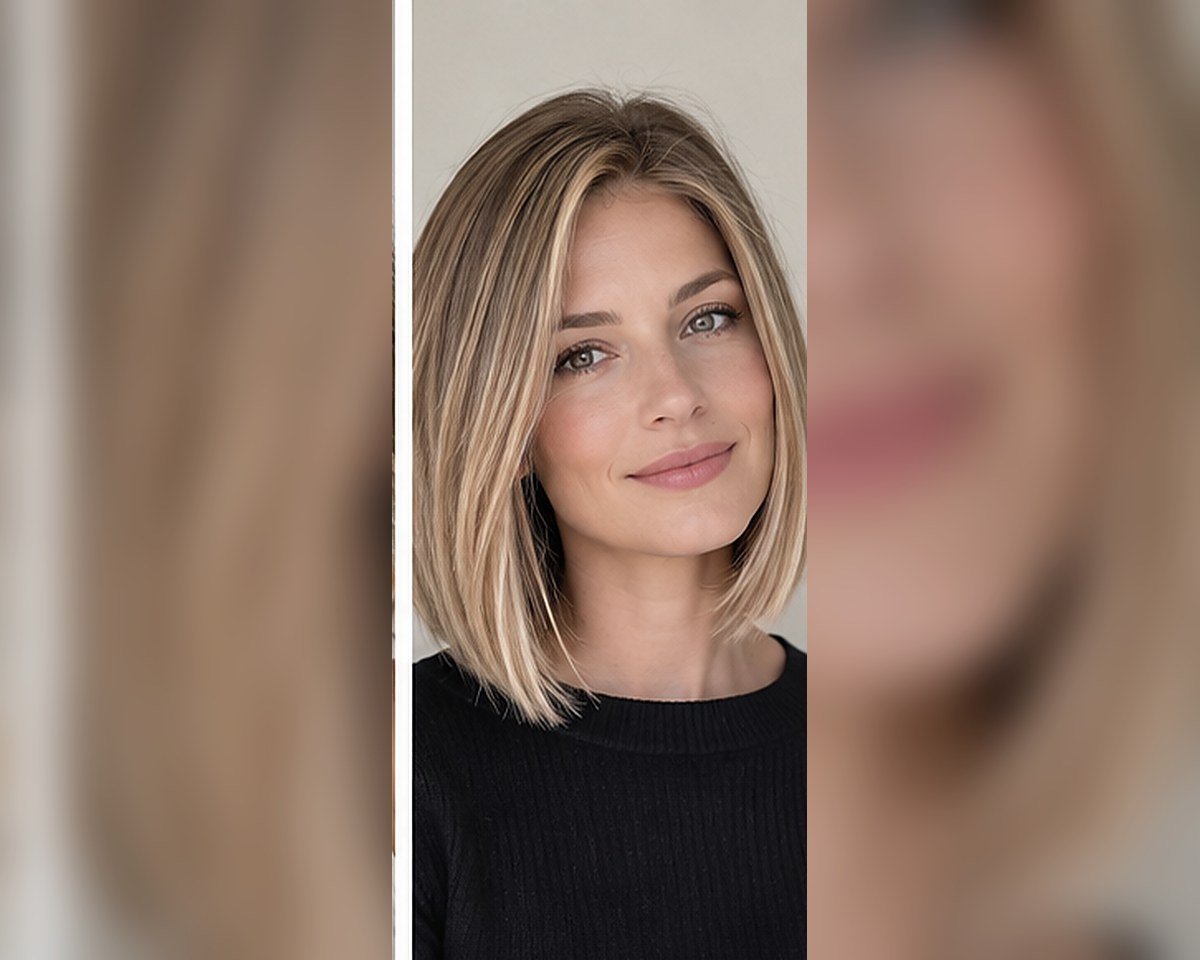
Straight fine hair makes the trade-off between movement and density especially visible. A strong perimeter can make the ends look fuller; too many short layers can make the lower edge disappear even when the haircut looks airy in a styled photo.
Here the focus is narrower than the general low-maintenance discussion: straight fine hair and cuts that still look intentional after ordinary brushing, air-drying or a quick root refresh.
The blunt bob remains useful for a reason
A bob concentrates visual weight around the bottom. For straight fine hair, that can make the ends appear denser even when the actual number of strands has not changed.
The length matters. A jaw-length bob feels sharper and may need more frequent trims. A longer bob near the collarbone grows out more quietly and gives you more styling options.
StyleVeya’s bob haircuts for fine hair compare shapes that preserve fullness rather than cutting it away.
A collarbone cut is the practical middle option
Not everyone wants a short bob. A collarbone cut gives straight fine hair enough length for a ponytail while removing some of the weight that makes longer hair lie flat.
This is also a useful length if you want to air-dry. The ends have enough structure to look finished without needing a round brush.
StyleVeya’s low-maintenance medium haircuts show why medium lengths tend to be forgiving during grow-out.
Long hair can still be low maintenance
Fine hair does not automatically need to be short. If you prefer long hair, the lowest-maintenance version is usually a clean perimeter with minimal interior layering. Keep as many strands as possible contributing to the lower edge so the ends still read as full.
Very long fine hair can look flat at the roots because of weight, but that does not mean the answer is aggressive layering. A modest length reduction can create more lift while preserving density.
See StyleVeya’s low-maintenance long haircut ideas if you want to keep significant length.
Be careful with “volume layers”
The phrase sounds perfect for fine hair, but layers do not create new density. They can help shorter sections lift away from the head, which creates movement. They can also remove so much weight from the ends that the haircut looks thinner overall.
For straight fine hair, the safest layers are often long and selective. Face framing from the chin down can make a simple cut feel softer without turning the whole haircut into a layered shape.
If you already know you like layers, compare StyleVeya’s layered haircuts for fine hair before choosing how much to remove.
Short cuts can be surprisingly easy
A pixie or short crop removes the weight that pulls fine hair flat. The trade-off is maintenance at the salon rather than maintenance at home. You may spend less time styling each morning but need more frequent trims to preserve the silhouette.
For straight hair specifically, StyleVeya’s short haircuts for straight hair show how shape prevents the cut from lying flat against the head.
Styling should support the cut, not rescue it
A low-maintenance haircut should look acceptable without a full styling routine. For straight fine hair, that usually means concentrating effort at the roots.
Drying the front and crown in the opposite direction from where they naturally fall can add more lift than covering the lengths with texture spray. Use lightweight products; heavy oils, rich masks and thick creams can make fine strands separate into smaller sections and expose more scalp.
Root lift and end fullness are separate problems
Straight fine hair can be flat at the roots and still look thin at the ends. Solving one problem by adding lots of layers can make the other worse.
If the roots collapse, focus on direction, parting and crown shape. If the ends look sparse, protect the perimeter. A good cut should balance both rather than sacrificing the bottom to create temporary lift at the top.
Parting can change how much volume you see
A fixed center part can make fine hair look flatter if the same roots are compressed every day. A slight side shift or occasional part change can create visible lift without changing the haircut.
If you know you always wear the same part, tell the stylist so the front and crown are cut to work with it.
Second-day hair should be part of the decision
Some cuts look excellent immediately after washing but lose shape by the next morning. If that is typical for you, choose a shape that can be refreshed quickly with a part change, light root drying or minimal product rather than one that needs a full restyle.
Watch the front hairline before adding fringe
Straight fine hair makes cowlicks and growth direction easy to see. A fringe can create shape, but it can also become the highest-maintenance part of an otherwise simple haircut if the front hairline naturally splits or lifts.
If you want softness around the face without daily fringe styling, longer curtain pieces or below-chin framing usually give more flexibility. For a broader comparison, use Bangs and Fringe Ideas.
Tie-back needs should decide the shortest front pieces
If you rely on a ponytail, clip or low bun, keep enough length around the temples and sides to stay secure. Fine hair can feel noticeably less dense when several front sections are cut too short to join the rest.
That does not mean avoiding face framing. It means choosing the first layer around the function you need instead of copying a reference whose styling routine is completely different.
Grow-out can be used to reduce salon frequency
A collarbone cut with a strong perimeter usually changes more gradually than a precision jaw-length bob. If longer gaps between appointments matter, choose a shape that still looks deliberate as the line drops rather than one that depends on staying at an exact point.
When the haircut starts to feel flat, check whether the issue is really length. Sometimes moving the part, cleaning up the perimeter or shortening only the front is enough without rebuilding the entire cut.
Common mistakes with straight fine hair
- Adding short crown layers to create “volume” and losing too much density.
- Using a heavily feathered perimeter that looks wispy by midday.
- Choosing a cut that only looks full after a salon blowout.
- Using rich styling products that separate fine strands into smaller sections.
Choose the cut around your actual mornings
If you shower at night and sleep on your hair, choose a shape that tolerates bends. If you always tie your hair back, keep enough length around the front to stay in the ponytail. If you never blow-dry, do not choose a cut whose reference photos are all smooth salon blowouts.
StyleVeya’s Style Finder can help narrow your options based on texture, maintenance and the way you actually wear your hair.
Straight fine hair can look polished with very little work when the haircut is built on restraint. Keep the lower edge strong, layer only where it solves a real problem and choose a length that works on an ordinary Tuesday—not only on salon day.