
Low maintenance does not mean no maintenance. It means the haircut keeps a believable shape as it grows, works with your natural texture and does not depend on a specific blow-dry every morning.
Medium length is well suited to that goal because it can keep enough weight to behave predictably while still feeling lighter than long hair. Medium Layered Haircuts is useful if you want more movement without adding daily work.
Choose a perimeter that still looks intentional after several weeks
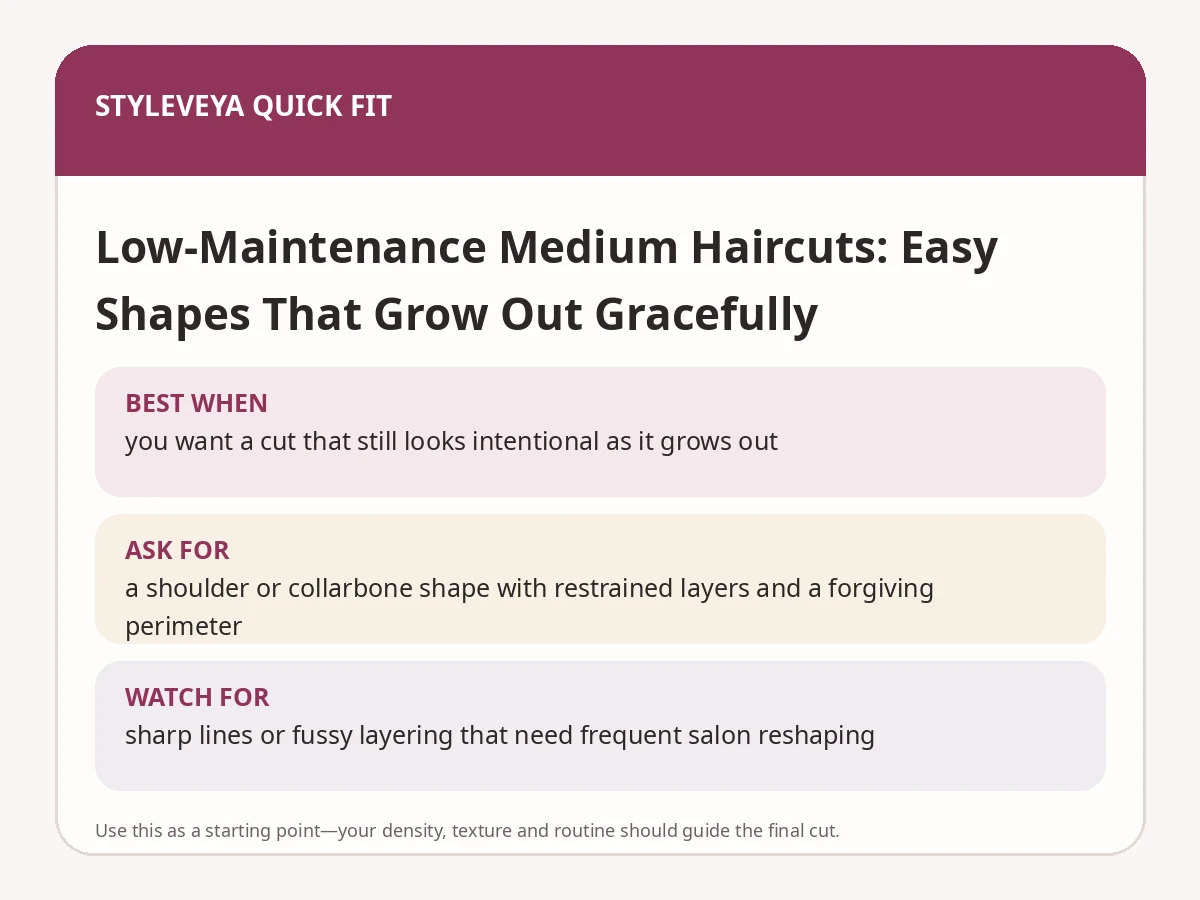
Soft, slightly textured edges usually grow out more forgivingly than razor-sharp lines. Shoulder and collarbone lengths also give you the option to tie the hair back when the shape is between trims.
If your hair flips at the shoulders, moving the line slightly above or below that contact point can reduce daily styling frustration.

Keep layers long enough to air-dry well
Longer layers tend to settle more predictably than short, disconnected pieces. They can remove weight while still allowing a simple ponytail, clip or half-up style.
Face framing should be long enough to behave when you do not style it with a round brush.
Natural texture is an asset in a low-maintenance cut
Straight hair benefits from a clean outline; wavy hair can use its bend for movement; curly hair needs enough shape to air-dry into a balanced silhouette.
Styling, maintenance and grow-out
The best routine is the one you already do. If you air-dry most days, ask for the cut to be assessed dry. If you heat-style once a week, do not build the haircut around a daily blowout.
Parting can change the balance without changing the cut
A center part keeps the front balanced, while a side part shifts more hair across the crown and can create quick lift. If your main complaint is flatness, test the part you naturally wear before asking for shorter layers.
That matters at medium length because extra crown layers can change the whole silhouette. If a small parting change already gives enough lift, you may be able to keep more fullness through the ends.
Think about how the haircut behaves on day two
A cut can look easy on wash day and become high-maintenance the next morning if the crown collapses, the front pieces flip or the lower edge loses shape. Notice which area actually fails first before adding more layers or shortening the whole cut.
For many people, a quick root refresh, a different part or a simple clip is enough. A low-maintenance haircut should give you that kind of fallback rather than requiring a complete restyle.
Choose the shortest front layer by function
If you regularly tuck the hair, wear headphones, use a clip or tie the hair back, the front pieces need to cooperate with those habits. Cheekbone-length framing creates more movement, but below-chin pieces are usually easier to control and grow out.
The difference can be small in a reference photo and large in daily life, so decide what the front needs to do before choosing how short it should be.
Maintenance can be salon time or morning time
A softer medium cut may need less frequent reshaping but take a little longer to dry. A sharper lob may be faster to style yet show growth sooner. Neither is automatically easier.
Choose which kind of maintenance you want to reduce. That answer should shape the haircut more than the label “low maintenance.”
Tell the stylist what low maintenance means for you
- Tell the stylist how often you realistically return for trims.
- Say whether you air-dry, diffuse or blow-dry.
- Ask for layers that still work without heat styling.
- Choose a perimeter that can grow out softly.
- Keep front pieces long enough for your everyday routine.
Low maintenance starts with your real routine
If you air-dry most days, the haircut should still look balanced without a round brush. If you tie it back for work or exercise, the front pieces need to cooperate with that. A low-maintenance cut is one that works with your habits rather than asking you to create new ones.
Fine hair usually needs restraint with layers
Fine medium hair can look thinner when the lower half is over-layered. A fuller perimeter with limited movement through the interior often gives a stronger result.
Thick hair may need internal weight control
Dense medium hair can feel heavy around the shoulders and sides. Removing bulk inside the shape can make styling easier without making the ends look wispy.
Wavy hair benefits from strategic rather than automatic layering
Natural wave already creates movement. Add layers only where they improve the shape or release excess weight rather than because medium cuts are “supposed” to be layered.
Face framing should stay practical
If you do not want daily styling, keep the shortest pieces long enough to tuck behind the ear or join a ponytail. Very short face framing can create more work even when the rest of the haircut is easy.
Choose an endpoint that avoids constant shoulder flipping
If your hair repeatedly kicks outward where it touches the shoulder, moving the length slightly above or below that point can reduce the need for heat styling.
Build the cut around your lowest-effort days
- Choose a fuller perimeter if density is your priority.
- Choose long internal layers if you want movement without daily styling.
- Keep face framing longer if easy tie-back matters.
- Adjust the overall length if shoulder contact creates an unwanted flip.
Which low-maintenance medium-length haircut fits your routine?
The best low-maintenance medium-length haircuts are the ones that solve the problem you actually have. Some people want fewer salon visits. Others want faster mornings, easier air-drying, less heat styling or a haircut that can still go into a ponytail. Those goals can point to different shapes.
| If your priority is… | Start with… | Why |
|---|---|---|
| Easy grow-out | Soft collarbone cut | The outline stays wearable as it gets longer. |
| Fine hair that looks fuller | Blunt or lightly layered medium cut | A stronger perimeter protects visual density. |
| Dense hair that feels heavy | Medium cut with internal weight removal | Bulk can be reduced without making the ends thin. |
| Natural wave and air-drying | Long, strategic layers | The wave gets movement without forcing daily styling. |
| Frequent ponytails or clips | Longer face framing | The front remains functional on low-effort days. |
Low-maintenance medium haircuts for straight hair
Straight hair usually shows the perimeter clearly, so the simplest option is often a clean shoulder or collarbone line with minimal layering. If the hair is fine, too many layers can reduce fullness. If it is thick, a small amount of hidden weight removal can make the cut easier to dry without changing the outside shape.
Low-maintenance medium haircuts for wavy hair
Wavy hair already has movement, so it does not need layers everywhere. Start by identifying where the wave begins and where the hair becomes widest after drying. A few longer layers can release weight while keeping the ends substantial. If the wave disappears when the hair gets too long, taking the length closer to the collarbone can help the pattern return.
Low-maintenance medium haircuts for curly hair
For curly hair, medium length can be useful because it keeps enough weight to control expansion while still allowing shape through the crown and sides. The shortest layer should be chosen with shrinkage in mind. A cut that looks shoulder length when wet may sit noticeably higher once the curls dry.
How to make a medium-length haircut easier between salon visits
Choose a shape that does not rely on a very sharp line staying perfect. Soft edges, restrained layering and practical front pieces usually age more gracefully. At home, focus on habits that support the cut you already have: air-dry in your normal part, refresh only the sections that need it, and use clips or a low ponytail instead of restyling the whole head.
If the haircut repeatedly becomes difficult at the same point in the grow-out cycle, note what changes first. It may be the front falling into the eyes, the ends flipping at the shoulder, the crown becoming flat or the lower shape becoming too heavy. That gives your stylist a specific adjustment to make next time instead of simply cutting everything shorter.
When “low maintenance” still means regular trims
A low-effort haircut can still benefit from maintenance. The difference is that the cut remains presentable between appointments. Softer medium shapes are often more forgiving than highly precise bobs because a small amount of growth does not immediately change the design. If you prefer a crisp line, expect to trade some morning simplicity for more regular salon upkeep.
Frequently asked questions
What medium haircut is easiest to maintain?
A soft shoulder or collarbone cut with restrained layers usually grows out well and gives you easy styling options.
Are bangs low maintenance with medium hair?
Usually not compared with longer face-framing pieces. Fringe can be worth it, but it needs more frequent trimming and daily attention.
How often should a low-maintenance medium cut be trimmed?
It depends on how precise the shape is. Softer cuts can often go longer between trims than blunt or highly structured styles.