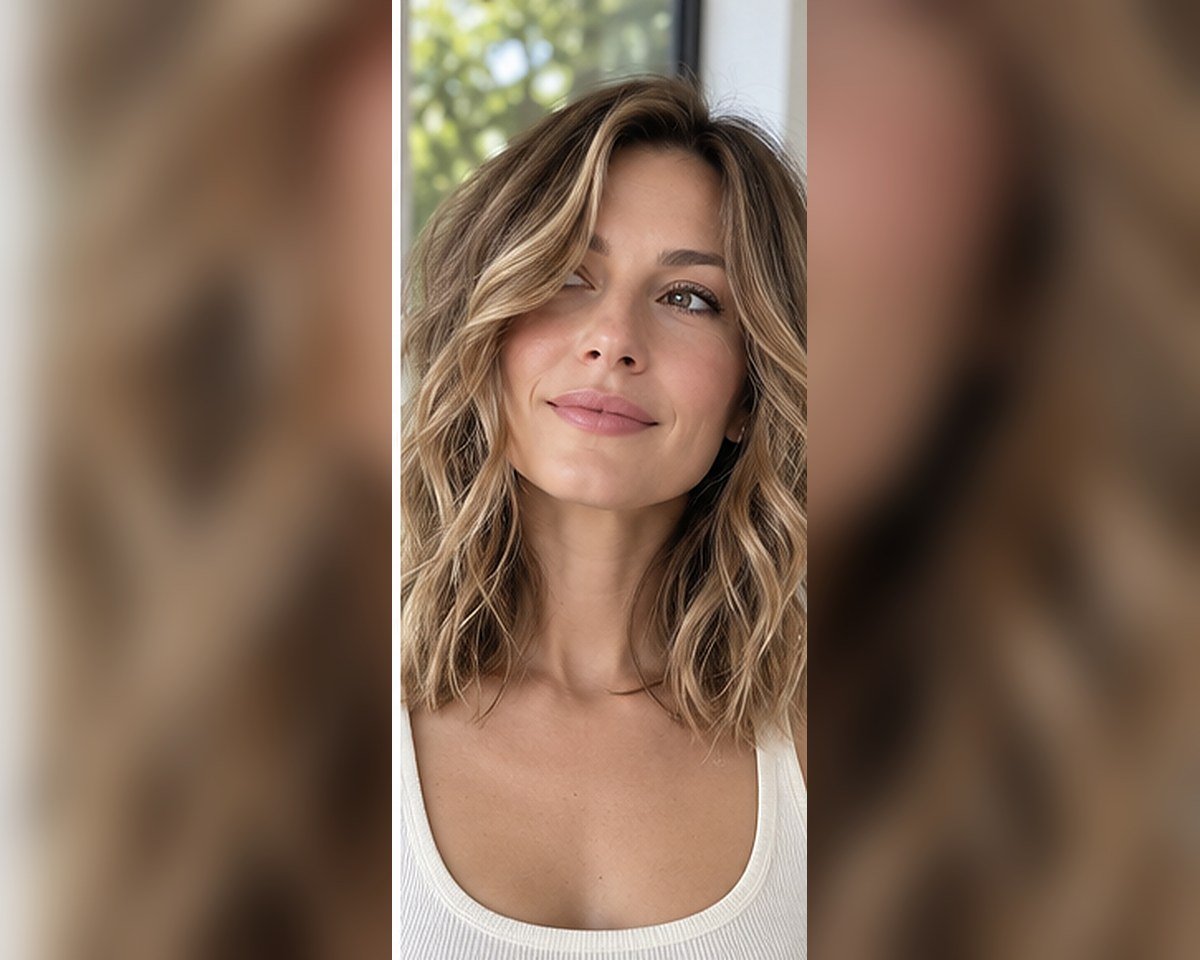
Fine wavy hair is easy to misread.
When it is wet, it may look sparse. When it dries, the wave can double the volume. Cut too many layers and the ends disappear. Leave everything one length and the top may fall flat while the bottom flips outward.
Shoulder length sits in a useful middle ground. There is enough length for the wave to form, but not so much that fine strands are pulled completely flat.
Keep more weight at the bottom than you think
Fine hair usually looks healthier when the ends have some density. That is especially true with waves. Each bend creates visual space between strands, so heavily feathered ends can look much thinner once the hair is dry.
StyleVeya’s shoulder-length haircut ideas are a useful starting point for comparing stronger and softer outlines.
If you already have very fine ends, ask for a clean perimeter first. Layers can be added above it rather than carving through the bottom.
Let the wave decide where the layers begin
Layer length should follow where your own wave begins and how much density you want to keep through the ends.
Some people have waves that start close to the scalp. Others stay almost straight until the lower half of the hair. Cutting a layer directly through the strongest bend can make that section kick outward.
A stylist who works with natural texture should look at your hair dry before finalizing placement. For more texture-specific ideas, StyleVeya’s wavy hair haircut hub and medium haircuts for wavy hair show how movement changes at this length.
Face framing can add movement without sacrificing density
You do not need layers through the entire head to make shoulder-length hair feel lighter.
A few longer pieces around the face can create shape while leaving most of the interior full. Starting around the jaw or collarbone often gives fine hair enough movement without removing too much from the sides.
If your front hairline is fine, avoid pulling a very deep section forward for face framing. That can make the temples look less dense.
A soft U-shape can be more forgiving than a severe V
A strong V-shaped perimeter removes a lot of hair from the front corners. That can be beautiful on dense hair but risky on fine hair.
A subtle U-shape keeps more fullness at the sides while still preventing the haircut from looking boxy. A mostly straight perimeter also works well when the wave is loose and the goal is maximum thickness.
StyleVeya’s article on fine hair at shoulder length goes deeper into where layers help and where they begin to work against the haircut.
Styling fine waves without collapsing them
Fine wavy hair usually responds better to lighter products. A small amount of mousse or lightweight gel can help clumps form without coating every strand. Apply product while the hair is wet, then scrunch gently.
Avoid aggressively rubbing the hair with a towel. That separates the wave before it has a chance to set.
If you diffuse, use lower airflow and stop before the hair feels bone-dry. Excessive handling is one of the fastest ways to turn fine waves into frizz.
Shoulder contact can change the way fine waves sit
Hair that lands directly on the shoulder can flip outward, especially when the wave is loose. If that happens consistently, moving the perimeter slightly above or below the shoulder may create a more predictable shape than adding more layers.
Humidity can make fine waves look wider but not necessarily fuller
Fine wavy hair may expand in humid air while still looking light through the ends. That is another reason to preserve perimeter density and avoid removing too much internal weight.
Second-day hair should influence the cut too
A haircut can look balanced on wash day but collapse at the crown the next morning. If that is your pattern, ask for enough movement around the top to refresh easily without sacrificing the lower density.
Notice what actually changes overnight. If only the crown goes flat, adding more layers through the whole haircut is unnecessary. If the lower waves lose shape while the top stays full, the problem may be product weight, sleep friction or the way the ends are sitting on the shoulders rather than the haircut needing more texture everywhere.
Parting can change where fine waves look fullest
A middle part can make the front look even and clean, but it may also reveal a flatter crown if the hair naturally falls away from the center. A side part shifts more hair across the top and can create quick root lift without changing the cut.
Test your usual part on a normal air-dry day before asking for shorter crown layers. If moving the part already gives you the lift you want, you may be able to keep more density through the haircut.
Tie-back needs should affect the face frame
If you regularly use a ponytail, clip or low bun, tell the stylist before the front pieces are shortened. Fine hair can feel much thinner when several face-framing sections no longer reach the tie-back point.
You can still have movement around the face; the useful question is how short the first piece needs to be. Jaw- or collarbone-level framing often keeps more flexibility than cutting multiple short pieces through the temples and cheek area.
Common mistakes to avoid
- Cutting too many short layers through already fine ends.
- Using a deep V-shaped perimeter that removes too much side fullness.
- Choosing face framing so short that it exposes sparse temples.
- Building the cut around a salon blowout when you usually air-dry.
How to choose the shoulder-length shape
- Choose a fuller perimeter if your ends are light.
- Use longer layers if you want more bend without losing density.
- Move the overall length if the shoulder makes the ends flip.
- Keep face framing lower if temple density is a concern.
A useful salon request
Ask for shoulder length with a full perimeter, very soft layers that follow the wave and light face framing that does not thin the sides.
If you want to be more precise, bring a dry photo of your own hair on a typical day—not only inspiration images. That shows the stylist how your texture actually behaves.
StyleVeya’s how to choose a haircut guide is useful for comparing texture, density and maintenance before you commit.
Shoulder-length hair can be one of the easiest lengths for fine waves when the cut respects both parts of the equation: the strands need fullness, and the wave needs room to move.