
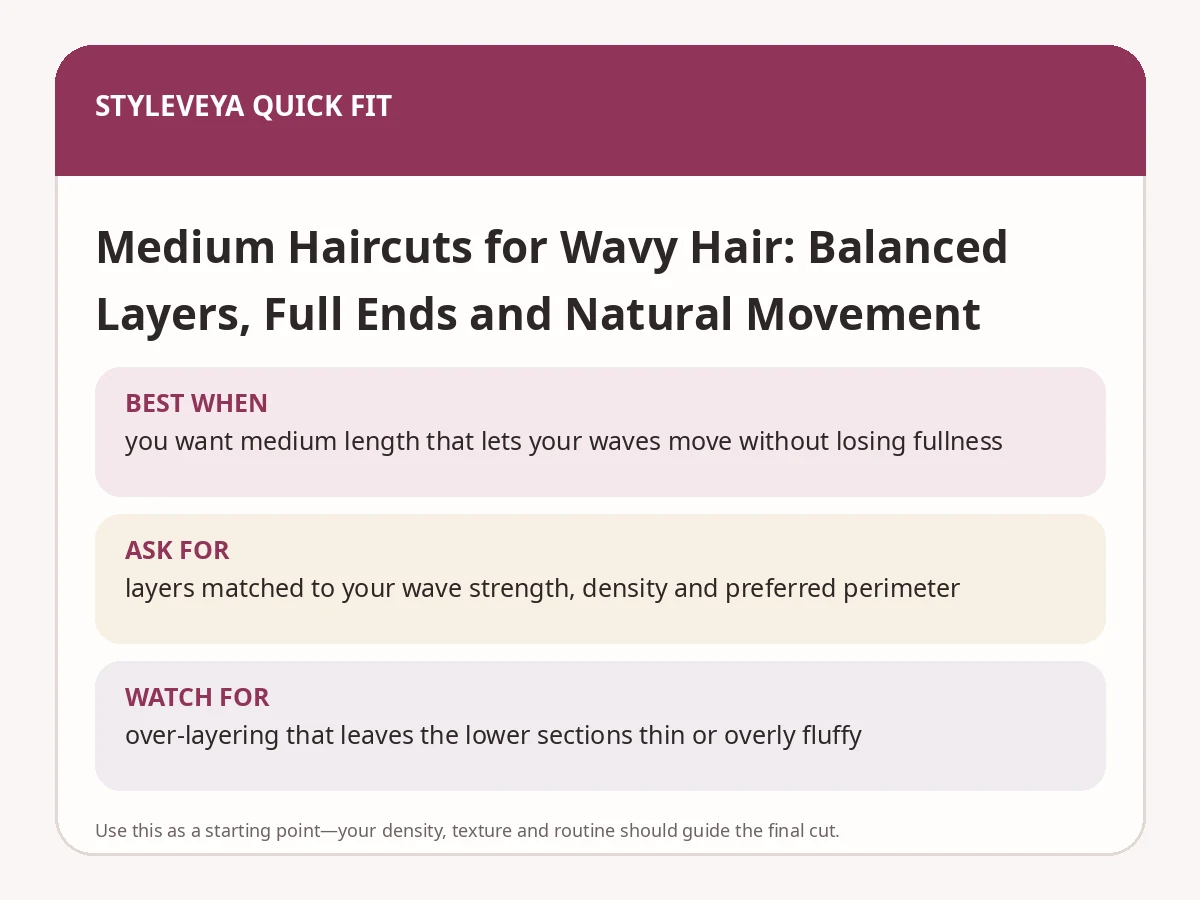
Medium length gives wavy hair enough room to form a visible S-pattern without the weight of long hair pulling every bend downward. The challenge is keeping enough perimeter weight that the ends look full while releasing enough bulk for the waves to move.
Shoulder and collarbone lengths are especially flexible because they can be worn air-dried, diffused, softly blown out or tied back. Shoulder-Length Haircuts is useful if you want to compare the same length across different textures.
Layer placement should follow where the wave naturally bends
If the shortest layer ends at a natural bend, the hair often moves more easily. If it ends in a straighter zone, that section can stick out or feel disconnected.
Loose waves may need only a few long layers; stronger waves can support more internal shape.

Keep the lower edge substantial enough to anchor the wave
A medium wavy cut can become frizzy-looking when the bottom is over-thinned. A solid or softly textured perimeter gives the wave something to build on.
Face framing can begin higher without forcing the entire cut to be heavily layered.
Density changes the amount of internal shaping needed
Fine waves usually need more weight. Thick waves can benefit from internal bulk control so the sides do not become too wide.
Styling, maintenance and grow-out
Ask for a cut that looks balanced after your normal air-dry or diffuser routine. If you only occasionally blow the hair smooth, the natural state should still be the design baseline.
Watch where the wave changes direction
Medium wavy hair often contains sections that bend in opposite directions. One side may turn inward while the other flips out, or the front may form a stronger S-pattern than the back. Cutting every section to match one reference shape can make those differences more obvious.
Before the cut, let the hair dry in its usual state and note which areas consistently turn under, kick outward or stay comparatively straight. Layer placement can then follow the pattern rather than fighting it.
Parting can create lift without shorter crown layers
If the crown feels flat, try your usual middle and side parts before asking for more short layering. Moving the part shifts weight across the top and may create enough root lift on its own.
This is especially useful for medium cuts because the overall length is long enough to hold some weight but short enough for the front shape to change visibly. The Side Part vs Middle Part guide explains that effect in more detail.
Fringe should be planned separately from the rest of the layers
A medium wavy haircut can be easy to maintain while the fringe becomes the high-effort part. Shorter front pieces react quickly to cowlicks, humidity and sleep, so decide whether you want true bangs or longer face framing before taking the front much shorter.
If you need the front to tuck behind the ears or reach a ponytail, keep that function in the brief. For wider fringe comparisons, use Bangs and Fringe Ideas.
Second-day shape is part of the haircut test
Waves often soften overnight. If only the crown goes flat, the answer may be a different part or a quick root refresh rather than more layers throughout the haircut. If the ends lose definition first, check whether heavy product or shoulder friction is affecting the lower half.
A useful medium cut should be refreshable without rebuilding every wave from scratch.
Set the dry length and layer placement
- Show your natural wave before it is straightened.
- Choose the dry endpoint around the shoulder or collarbone.
- Ask where the shortest layer will land in the wave pattern.
- Keep enough perimeter density for full ends.
- Explain whether you air-dry, diffuse or alternate between textures.
Shoulder length and collarbone length behave differently
A cut that sits directly on the shoulder may flip outward where the ends touch clothing. Moving the length slightly above or below that point can make the shape more predictable.
If your hair repeatedly kicks out at the shoulder, changing the endpoint may help more than adding extra layers.
Fine waves usually need more perimeter weight
Fine wavy hair can lose visual density quickly when too many layers are added. A stronger bottom edge with limited internal movement often gives the wave enough structure without making the ends look sparse.
For a more targeted version, see shoulder-length haircuts for fine wavy hair.
Thick waves may need internal bulk control
Dense wavy hair can become triangular when the perimeter is heavy and the sides carry too much weight. Internal shaping can reduce width while preserving the outer line.
Controlled weight removal works better than aggressive thinning; remove bulk only in the areas that actually need it.
Face framing can change the cut without changing the whole structure
If you want more movement around the face but do not want layers everywhere, shorter front pieces can create visible change while the back stays fuller.
Choose the shortest point based on whether you need those pieces to tuck behind the ear or reach a ponytail.
Plan for your real styling routine
If you air-dry most days, the haircut should look balanced in that state. If you diffuse occasionally, the same shape should still work without depending on maximum volume.
A cut that only looks good after a salon blowout is not genuinely low-effort for someone who rarely blow-dries.
Balance movement with a full perimeter
- Choose a fuller perimeter if your waves are fine or your ends already feel light.
- Choose internal shaping if the sides become bulky or triangular.
- Choose longer layers if you want movement without losing tie-back ability.
- Adjust the overall length if shoulder contact repeatedly makes the ends flip.
Frequently asked questions
Should medium wavy hair be layered?
Often yes, but the amount depends on density and how strongly the hair bends. Loose waves may need very little layering.
What length works best for wavy hair?
Shoulder and collarbone lengths are versatile because they allow the wave to form while keeping enough weight for control.
How do I stop medium wavy hair from getting triangular?
Strategic internal shaping and well-placed layers can distribute width without thinning the entire perimeter.