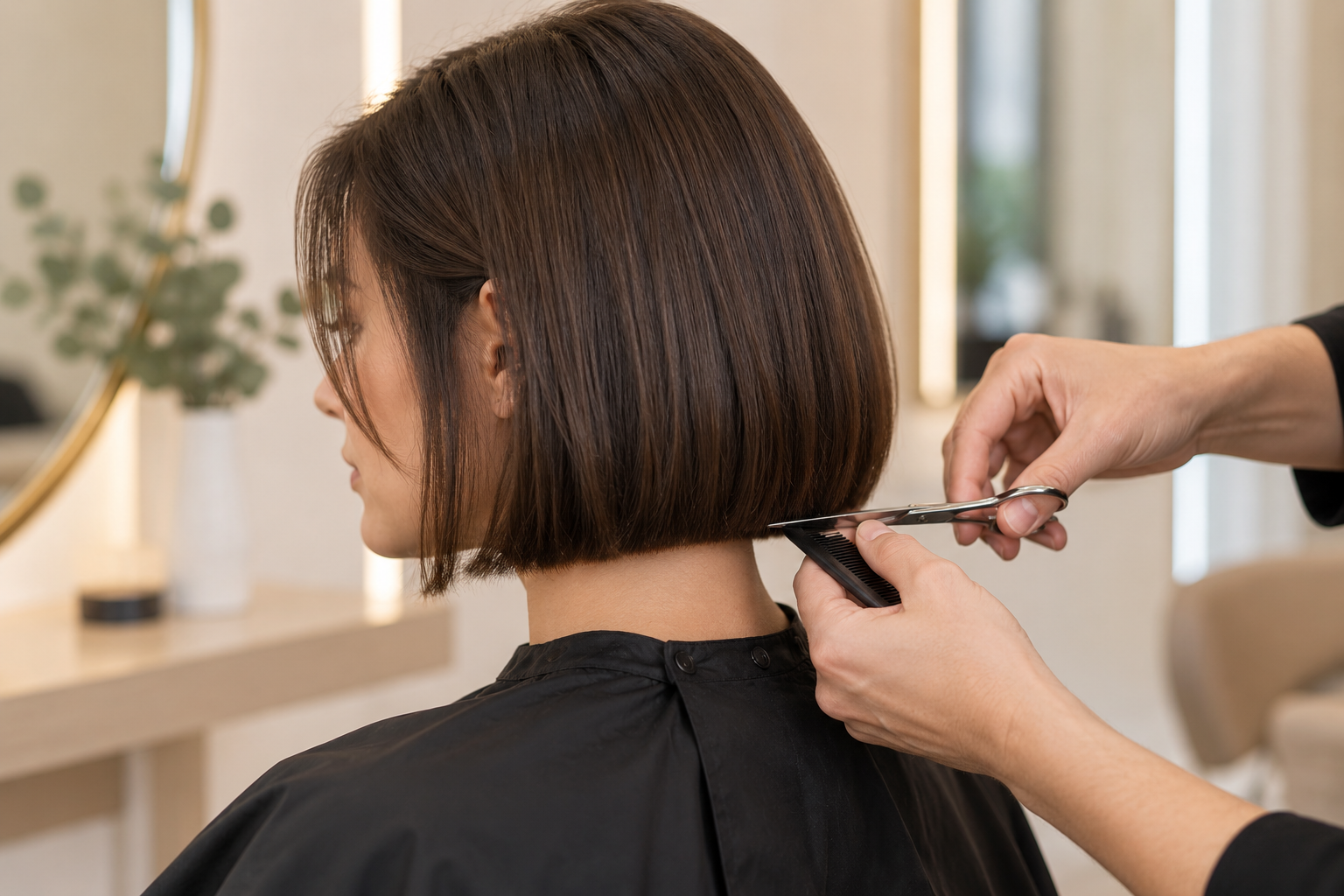
A bob is one of those haircuts people describe as “high maintenance,” but that phrase is too vague to be useful. A sharp jaw-length bob, a soft wavy bob and a collarbone lob can all belong to the same family while needing very different trim schedules.
Instead of using one fixed trim interval, notice which part of your bob stops working first.
For some people, the neckline loses its shape. For others, the front becomes too long. A wavy bob may look good for months because the texture disguises small changes, while a geometric blunt bob can show a quarter-inch of growth immediately.
A sharp bob usually needs attention sooner
The cleaner and more architectural the outline, the sooner growth becomes visible.
A jaw-length blunt bob depends on a precise perimeter. As the hair grows, the line drops, the corners soften and the relationship between the front and back begins to change.
If that exact shape is the reason you chose the haircut, you may prefer more frequent trims. If you do not mind the bob gradually becoming a lob, you can stretch the interval much longer.
StyleVeya’s blunt bob guide shows why perimeter strength is such a large part of the look.
Graduated and stacked bobs lose their back shape differently
A stacked bob is not just a short perimeter. Its silhouette depends on graduation through the back.
As it grows, the nape can start to feel heavy while the upper layers lose the lift that made the cut look intentional. That means someone with a stacked bob may want the back cleaned up before the front feels particularly long.
If that is your shape, compare the examples in StyleVeya’s stacked bob haircut collection.
Thick hair may need shape maintenance before length maintenance
Dense hair can hold a bob beautifully, but it can also accumulate bulk as the interior grows.
The perimeter may still look fine while the sides begin to feel wide or the back starts pushing outward. In that situation, a maintenance appointment may focus on internal weight and balance rather than taking a large amount off the overall length.
The new guide to a short layered bob for thick hair explains why removing weight is different from simply thinning the ends.
Fine hair can often grow longer before the shape feels heavy
Fine hair usually does not create the same bulk problem, but the perimeter can begin looking weaker if the ends become worn.
If your bob was chosen to make fine hair look fuller, preserving a clean lower edge may matter more than maintaining the exact original length.
A small dusting of the ends can sometimes restore the outline without resetting the haircut completely.
For more examples, see StyleVeya’s bob haircuts for fine hair.
Wavy hair hides small changes—but not all of them
Natural wave can disguise a slightly uneven perimeter because the ends do not fall in one rigid line.
That gives many wavy bobs a forgiving grow-out. As the length changes, the wave can also change where it bends. A section that originally curved inward may begin flipping outward once it reaches the shoulder.
If your bob is approaching that stage, StyleVeya’s wavy bob ideas and shoulder-length guide for fine wavy hair show how the same texture behaves at different lengths.
Curly bobs should be judged dry
Curls do not grow out in the same visually predictable way as straight hair. A small increase in length can change how individual curls stack, shrink and connect with the overall silhouette.
That is why the calendar alone should not decide the trim.
If the shape still looks balanced dry, the fact that a certain number of weeks has passed is not a reason to cut it. If one section has begun collapsing or expanding differently, that is a more useful signal.
Your neckline is often the first checkpoint
On shorter bobs, look at the nape before looking at the front.
If the bottom begins forming a heavy shelf, flicking outward or sitting awkwardly over collars, the back may need maintenance even if you still like the front length.
This is especially relevant for inverted and graduated shapes where the back is deliberately shorter.
Decide whether you are maintaining or growing
A maintenance trim and a grow-out trim have different jobs.
If you want to keep the bob exactly where it is, the stylist can restore the original perimeter, remove excess interior weight and refine the face framing.
If you are growing it out, the goal may be to remove as little length as possible while adjusting the sections that become awkward first.
That difference matters. Telling a stylist “just tidy it” is not as clear as saying, “I am growing toward the collarbone, so keep the front length and only rebalance the back.”
Do not choose a trim interval just because someone online uses it
Fixed rules such as “trim every six weeks” are easy to remember, but they ignore texture, haircut geometry, chemical history, heat styling and personal preference.
The American Academy of Dermatology emphasizes gentle hair care and reducing damaging practices rather than prescribing one haircut schedule for everyone. Its hair-damage guidance is a useful reminder that protecting the condition of the hair matters alongside keeping a fashionable shape.
Signs your bob is ready for a trim
- The perimeter no longer sits where you want it.
- The nape feels heavy or begins flipping outward.
- Face-framing pieces no longer connect with the rest of the cut.
- The ends look visibly worn even though you like the current length.
- The back has lost graduation or lift.
- The cut suddenly requires much more styling to look like itself.
That last sign is especially useful. A good bob often becomes noticeably harder to style before it looks dramatically overgrown.
Bring the grow-out goal to the appointment
If you want to keep the bob, say so. If you want a lob in three months, say that instead.
StyleVeya’s Stylist Brief is useful for writing down the target length, how you wear the hair most days and which part of the current shape is bothering you.
There is no perfect number of weeks for every bob. The right interval is the point where the haircut stops doing the job you chose it for. Maintain the geometry if you love the geometry; stretch the grow-out if you like the softer shape. The calendar is only a reminder—the silhouette is the real test.