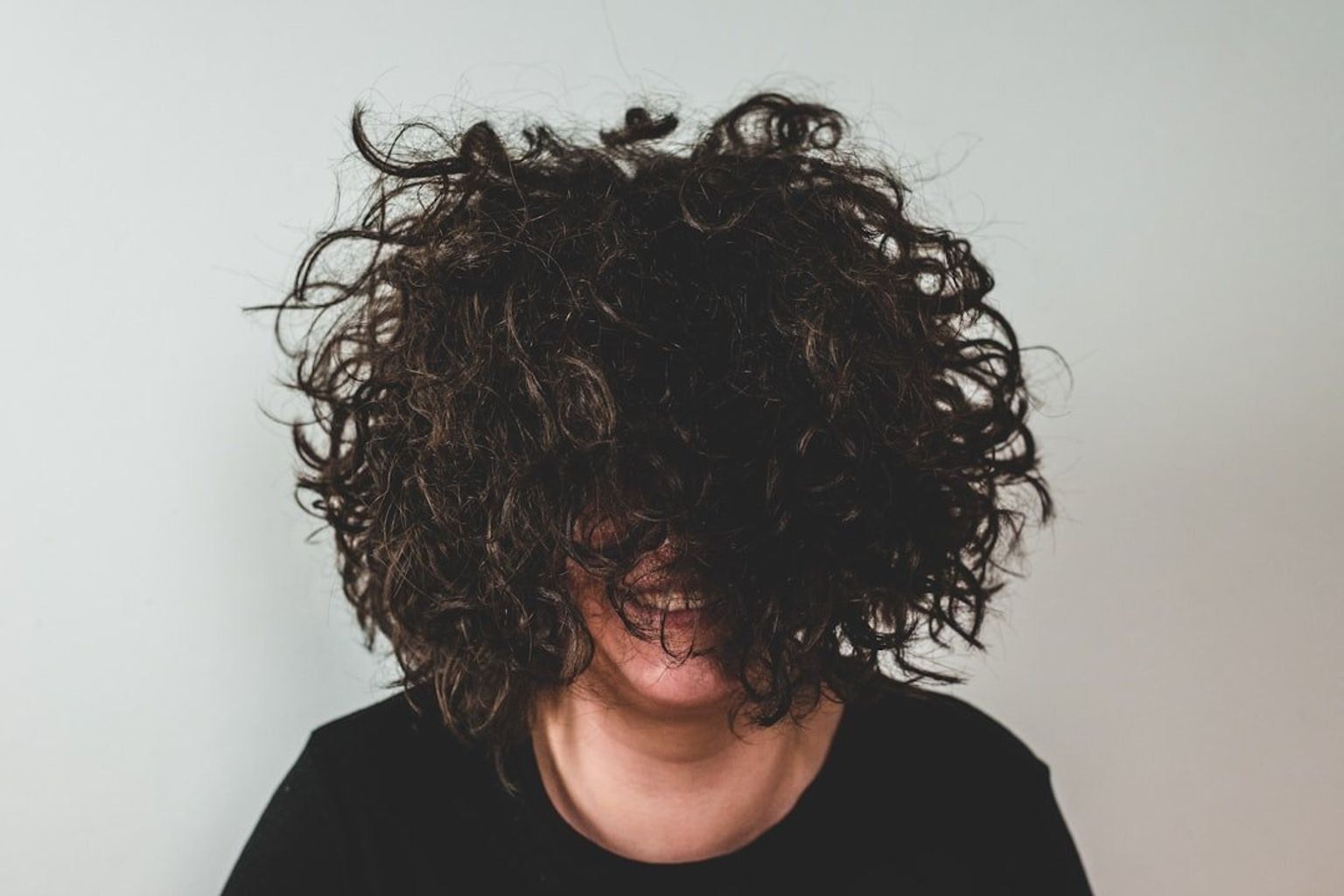
A curly shag works when the layers create movement without removing so much weight that the haircut becomes top-heavy or see-through at the ends. The answer is not “more layers everywhere.” It is a deliberate distribution of length that lets curls stack, spring and separate in the places where you actually want volume.
That balance is what prevents the classic triangle problem: flat or heavy at the crown, wide through the lower half, and disconnected around the perimeter.
Start with the dry shape, not the haircut name
“Curly shag” can describe several silhouettes. Some are short and rounded. Others are shoulder-length with a strong fringe. Some keep a fuller perimeter, while others have deliberately airy ends.
Before choosing one, decide what you want to see when the hair is fully dry:
- More lift at the crown?
- Less width at the sides?
- More movement around the face?
- A lighter perimeter?
- A fringe or open forehead?
Those decisions matter more than matching a trend label.
The crown needs lift, not a shelf
Shorter crown layers can release curls that are being stretched by length.
If the shortest layer is cut too abruptly, however, the top can puff separately from the rest of the haircut. The result looks like a shelf of short curls sitting on longer curls below.
A softer transition usually creates more natural volume because each layer has something to connect with.
StyleVeya’s shag haircut hub shows how the general shag shape changes across textures.
Shrinkage changes every measurement
Wet curls can look dramatically longer than they do once dry.
If your pattern tightens strongly, the shortest layer should be planned around dry length. Cutting a conservative amount first is easier to adjust than discovering that a crown layer springs far above the intended point.
This is why a dry check matters even if the main cutting work is done wet.
Different curl patterns may need different layer lengths
Not every section of curly hair behaves the same way.
The front may curl more tightly than the back. The underneath may be looser. One side may shrink more because of growth pattern or styling habits.
That means a perfectly identical wet measurement can produce an uneven dry result.
A curl-aware haircut responds to how each area behaves rather than forcing every strand into the same formula.
The perimeter still matters
Curly shags are often photographed with separated, wispy ends, but that finish does not suit every density.
Fine or lower-density curls may look stronger with more weight preserved through the bottom. Very dense curls may need interior weight removed so the lower half does not become too wide.
The correct perimeter is the one your density can support.
Fine curls need restraint
Fine strands can create beautiful movement, but too many short layers can make the bottom look sparse.
If fullness is important, keep more of the lower edge intact and use fewer, better-placed layers around the crown and face.
Do not assume a shag must have extremely feathered ends to count as a shag.
Dense curls may need internal space
Very dense curly hair can create a wide silhouette even when the perimeter is attractive.
Internal shaping can create room for curls to sit inside one another without cutting the visible surface excessively short.
Create controlled space for the curls instead of thinning randomly.
A triangle shape usually comes from weight distribution
If the top lies flat while the lower half expands, the haircut may have too much weight low down and not enough movement above.
The answer is not always to thin the bottom heavily. Sometimes adding controlled crown and mid-length layers changes the silhouette more effectively.
Length changes how much the curls stretch
Longer curls are pulled downward by their own weight. Shorter curls usually spring more.
If your current hair is long and you cut it to medium length, expect more movement even before the layers are considered.
StyleVeya’s medium curly haircut guide and long curly haircut guide show how the same texture can change with length.
The fringe is a separate shrinkage decision
A curly fringe can complete a shag, but it also creates the shortest visible curls near the face.
Decide whether you want a true forehead fringe, eyebrow-grazing curls or longer pieces that can sweep away.
If you are unsure, start longer. It is easier to shorten after seeing the dry result than to undo a fringe that springs higher than expected.
Your part changes the crown shape
A middle part distributes curls more evenly. A side part can create more volume on one side and change where the shortest face-framing pieces sit.
If you switch parts often, tell the stylist. Highly directional layers may look perfect in one part and disconnected in another.
StyleVeya’s parting guide explains how weight moves when the part changes.
Air-drying and diffusing create different results
A haircut that looks balanced when fully diffused may sit differently when air-dried.
Diffusing can encourage more root lift and curl formation. Air-drying may create more weight at the crown and a softer pattern.
If you do both, the haircut needs enough flexibility to look intentional in both states.
StyleVeya’s air-dry haircut guide is useful if most wash days involve minimal heat.
Do not thin curls just because they are dense
Removing weight can help, but repeated thinning close to the surface may create short pieces that frizz or push outward.
Ask where the weight is being removed and what shape problem the technique is intended to solve.
If the answer is simply “your hair is thick,” ask for more detail.
Bring your normal styling routine to the consultation
Tell the stylist:
- Whether you air-dry or diffuse.
- Whether you brush the hair while dry.
- What products you normally use.
- How much shrinkage you see.
- Whether you wear the hair up often.
- Whether you stretch or straighten it sometimes.
A shag designed only for a fully diffused salon finish can be frustrating if your normal routine is completely different.
Ask for the shortest layer to be shown to you
Before cutting the crown dramatically shorter, ask the stylist to indicate where that layer is expected to land dry.
This gives you a concrete reference instead of relying on vague words like “short” or “lots of layers.”
Humidity changes volume, but the haircut still matters
Humidity can increase expansion and frizz, especially on textured hair, but a balanced haircut should still have a recognizable silhouette.
The answer is not to eliminate all expansion. It is to distribute the shape so extra volume does not collect only at the bottom or only around the crown.
A good shag should grow out in stages, not collapse suddenly
Very short crown layers can become awkward as they grow through the curve of the head.
If you prefer longer gaps between trims, slightly longer crown layers may be easier to live with even if they create less dramatic lift on day one.
A practical salon request
You might say:
- I want crown lift without a disconnected short top.
- Keep enough weight through the perimeter for my density.
- Plan the shortest layer for dry shrinkage.
- Frame the face from this point.
- I air-dry/diffuse most of the time.
- I want the fringe long enough to sweep away if needed.
The StyleVeya Stylist Brief can help organize those details before the appointment.
The best curly shag is controlled, not maximum
More layers do not automatically mean more curl, more volume or a better shag.
A balanced curly shag gives the crown enough freedom to lift, keeps the sides from becoming a heavy triangle and preserves the perimeter your density needs and respects how much each curl shrinks.
When those pieces work together, the haircut still looks intentional after humidity, wash-day variation and ordinary styling—not only under salon lighting.